- Home
- About Us
- Industry
- Services
- Reading
- Contact Us
Southeast Asia Automotive Upholstery Market: Current Analysis and Forecast (2025-2033)
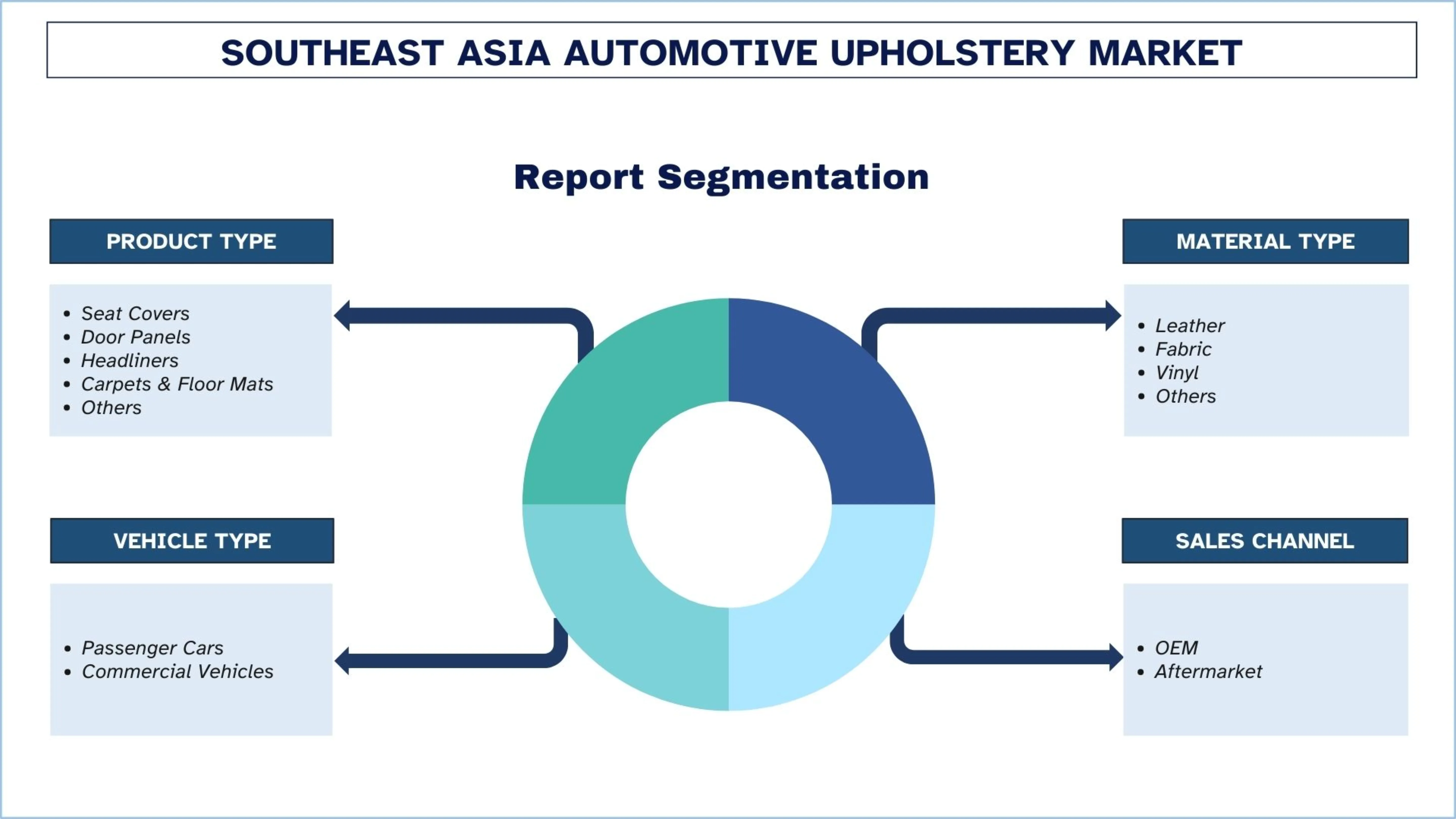
Emphasis on Product Type (Seat Covers, Door Panels, Headliners, Carpets & Floor Mats, Others); Material Type (Leather, Fabric, Vinyl, Others); Vehicle Type (Passenger Cars, Commercial Vehicles); Sales Channel (OEM, Aftermarket); and Country.
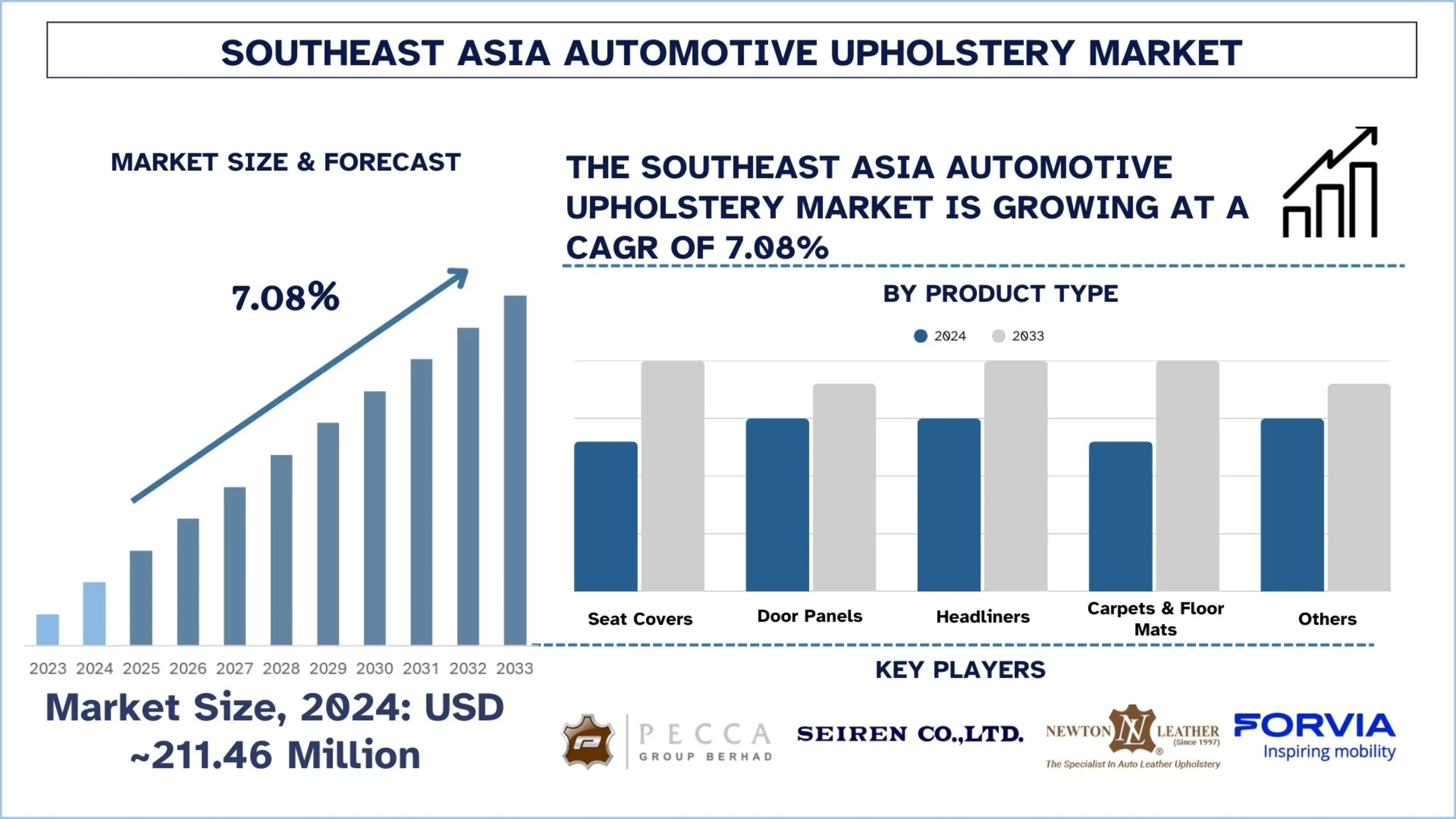
Southeast Asia Automotive Upholstery Market Size & Forecast
The Southeast Asia Automotive Upholstery Market was valued at ~USD 211.46 million in 2024 and is expected to grow at a strong CAGR of approximately 7.08% during the forecast period (2025-2033F), driven by the increasing passenger car production and rising disposable incomes.
Southeast Asia Automotive Upholstery Market Analysis
Automotive upholstery is a type of interior covering system produced using leather, fabric, vinyl, and composite materials that are designed to improve the functionality of the vehicle, meeting specifications or safety standards, as well as the perceived value of the vehicle in passenger and commercial automotive markets.
To achieve market growth, manufacturers in Southeast Asia are focusing on localized production, material cost optimization, and expanded aftermarket reach. The use of synthetic and sustainable materials improves the balance of cost and premium appearance, while automation in cutting, stitching, and lamination increases scale and consistency. Moreover, companies are empowering aftermarket supply chains, online personalization, and regional supply chains to recognize the need for a larger vehicle parc and greater personalization.
For instance, on October 13, 2025, Adient, a global leader in automotive seating, and Autoliv, a leading supplier of automotive safety systems, have co-developed innovative safety solutions that significantly enhance occupant protection in deeply reclined seating positions, commonly referred to as zero-gravity. These solutions, now ready for mass production, combine Adient’s new seating concept, Z-Guard, with Autoliv’s advanced safety technologies.
Southeast Asia Automotive Upholstery Market Trends
This section discusses the key market trends that are influencing the various segments of the Southeast Asia Automotive Upholstery market, as found by our team of research experts.
Increased Automation in Upholstery Manufacturing
The automotive upholstery market in Southeast Asia has become a significant focus of automation, with manufacturers adopting automated cutting, stitching, and lamination equipment to enhance productivity. Also, these systems minimize material waste, improve dimensional precision, and maintain high-quality consistency at high manufacturing volumes. Adding to this, automation helps suppliers manage labor-cost pressures and scale to meet increasing OEMs (original equipment manufacturers) demand. As vehicle programs become more complex, automated processes enable faster turnaround times and support more valuable, high-precision upholstery applications.
Southeast Asia Automotive Upholstery Industry Segmentation
This section provides an analysis of the key trends in each segment of the Southeast Asia Automotive Upholstery market, along with forecasts at the country level for 2025-2033.
The seat covers segment held the dominant share of the Automotive Upholstery market in 2024.
Based on product type, the market is segmented into seat covers, door panels, headliners, carpets & floor mats, and others. Among these, the seat covers segment held the largest share in 2024. This is primarily because they can fit any type of vehicle and are also frequently replaced. The OEM market is also robust because seating systems are a premium interior component, and the aftermarket drives incremental volume through customizations and wear-based replacements. Such a dual-demand structure prompts suppliers to scale production and expand their material portfolio to accelerate adoption across different price points. In November 2025, Pecca Group Bhd stepped up its transformation into an integrated seat and interior systems provider, targeting Tier-1 automotive component manufacturer status by 2026 as it deepens its presence across the automotive, aviation, and locomotive sectors. According to the upholstery manufacturer, the move expands its scope to support a broader range of requirements across all three sectors by adding full seat assembly to its core expertise in designing and supplying leather upholstery for seats and components. The new seat assembly capability is expected to be commissioned in the second half of 2026 (2H26).
The leather segment is expected to grow at a significant CAGR during the forecast period (2025-2033).
Based on material type, the Southeast Asian Automotive Upholstery market is segmented into leather, fabric, vinyl, and others. Among these, the leather segment is expected to grow at a significant CAGR during the forecast period (2025-2033). Leather and leather substitutes facilitate market expansion by fueling the trend of vehicle premiumization in the Southeast Asian emerging markets. With rising consumer purchasing power, OEMs are increasingly offering leather or PU leather trims in mid-segment passenger cars, thereby increasing per-vehicle upholstery value. This transformation helps manufacturers increase margins, invest in material innovation, and expand production footprints across regions.
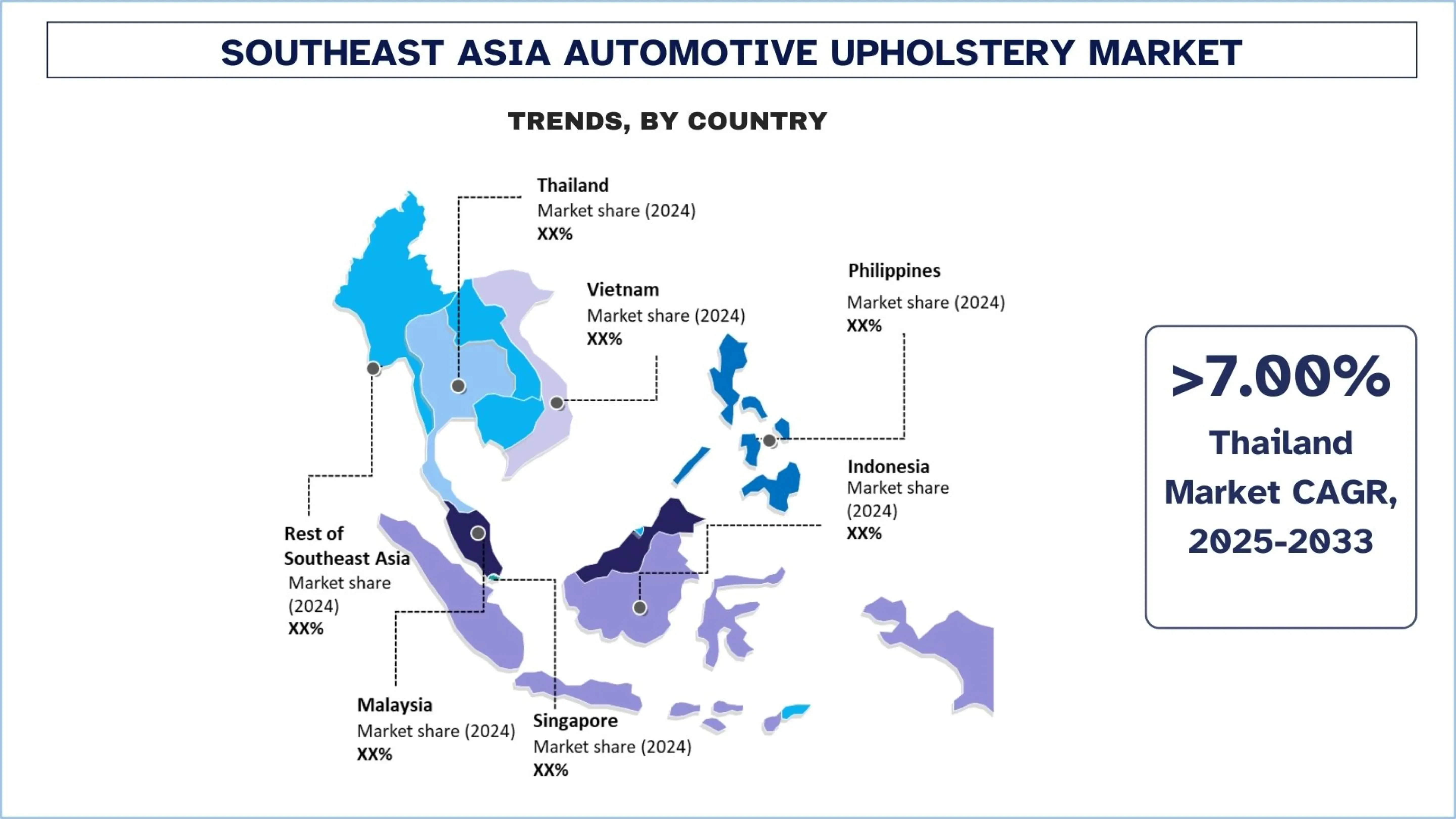
Thailand held a dominant share of the Southeast Asian Automotive Upholstery market in 2024
The automotive upholstery market in Southeast Asia has expanded in Thailand, the region's leading automotive manufacturing and export country. Additionally, high vehicle production volumes sustain strong OEM demand for seats, trims, and interior materials, thereby prompting upholstery manufacturers to localize their operations. The rapid adoption of EVs and improvements in platforms are increasing the per-unit value of interior components, particularly for high-quality and artificial leather. The suppliers of Tier-1 suppliers globally also increase technology transfer and capacity, thereby accelerating expansion.
On July 18, 2024, FORVIA, the world’s seventh-largest automotive technology supplier, and the Chinese automaker BYD inaugurated their new seat assembly plant in Rayong, Thailand. The facility was built under Shenzhen Faurecia Automotive Parts Co., a joint venture created by both companies in 2017 and majority-owned by FORVIA. Its construction began in July 2023.
Southeast Asia Automotive Upholstery Industry Competitive Landscape
The Southeast Asia Automotive Upholstery market is competitive, with several global and international market players. The key players are adopting different growth strategies to enhance their market presence, such as partnerships, agreements, collaborations, new product launches, geographical expansions, and mergers and acquisitions.
Top Southeast Asia Automotive Upholstery Companies
Some of the major players in the market are Pecca Group Berhad, SEIREN CO., LTD., Newton Leather Industries Sdn Bhd, OZ LEATHER JOINT STOCK COMPANY, Interhides Public Company Limited, Innova Pte Ltd, Adient plc, Thai Summit Group, TOYOTA BOSHOKU CORPORATION, and FORVIA Group.
Recent Developments in the Southeast Asia Automotive Upholstery Market
On December 8, 2025, South Korea’s Kolon Industries signed a long-term supply contract with Autoliv, the world’s largest vehicle safety parts company. The agreement follows an MoU signed in April, under which Kolon Industries committed to increasing supplies of airbag materials. In accordance with the contract, Kolon Industries will build a new airbag material production facility in Vietnam, which will commence operation from 2028 with the latest production technology. The facility is estimated to have an investment capital of approximately USD 48 million.
On September 13, 2025, Antolin inaugurated its new industrial plant in Indonesia. This facility represents a decisive step in the company’s growth strategy in Southeast Asia and was developed in partnership with local partner AAA, a joint venture between APM and ARMADA AUTOPARTS. The new plant will initially produce headliners, with plans to potentially diversify into door panels, lighting systems, and integrated electronic solutions. These products are part of Antolin’s value proposition in modular and intelligent interior solutions, designed to simplify assembly lines and improve manufacturers’ operational efficiency.
On September 4, 2025, Antolin, a multinational leader in the design and manufacture of automotive interior components, inaugurated two new industrial plants in Thailand and Indonesia, consolidating its expansion in Southeast Asia, one of the industry’s most dynamic regions. The new plant in Thailand is located in a strategic area to serve global OEMs with a local presence, reinforcing key electrification projects in markets such as Vietnam, Malaysia, and Indonesia. This facility will operate as a center of excellence for modular and intelligent interior solutions, including modular headliners, door panels, and cockpits.
Southeast Asia Automotive Upholstery Market Report Coverage
Report Attribute | Details |
Base year | 2024 |
Forecast period | 2025-2033 |
Growth momentum | Accelerate at a CAGR of 7.08% |
Market size 2024 | ~USD 211.46 million |
Country analysis | Indonesia, Thailand, Philippines, Vietnam, Malaysia, Singapore, Rest of Southeast Asia |
Major contributing Country | Vietnam is expected to grow at the highest CAGR during the forecasted period. |
Companies profiled | Pecca Group Berhad, SEIREN CO., LTD., Newton Leather Industries Sdn Bhd, OZ LEATHER JOINT STOCK COMPANY, Interhides Public Company Limited, Innova Pte Ltd, Adient plc, Thai Summit Group, TOYOTA BOSHOKU CORPORATION, and FORVIA Group |
Report Scope | Market Trends, Drivers, and Restraints; Revenue Estimation and Forecast; Segmentation Analysis; Demand and Supply Side Analysis; Competitive Landscape; Company Profiling |
Segments Covered | By Product Type, By Material Type, By Vehicle Type, By Sales Channel, By Country |
Reasons to Buy the Southeast Asia Automotive Upholstery Market Report:
The study includes market sizing and forecasting analysis confirmed by authenticated key industry experts.
The report briefly reviews overall industry performance at a glance.
The report covers an in-depth analysis of prominent industry peers, primarily focusing on key business financials, product portfolios, expansion strategies, and recent developments.
Detailed examination of drivers, restraints, key trends, and opportunities prevailing in the industry.
The study comprehensively covers the market across different segments.
Customization Options:
The Southeast Asia Automotive Upholstery Market can further be customized as per requirements or any other market segment. Besides this, UnivDatos understands that you may have your own business needs; hence, feel free to contact us to get a report that completely suits your requirements.
Table of Content
Research Methodology for the Southeast Asia Automotive Upholstery Market Analysis (2023-2033)
We analyzed the historical market, estimated the current market, and forecasted the future market of the Southeast Asian Automotive Upholstery market to assess its application in major countries. We conducted exhaustive secondary research to gather historical market data and estimate the current market size. To validate these insights, we carefully reviewed numerous findings and assumptions. Additionally, we conducted in-depth primary interviews with industry experts across the Southeast Asian Automotive Upholstery value chain. After validating market figures through these interviews, we used both top-down and bottom-up approaches to forecast the overall market size. We then employed market breakdown and data triangulation methods to estimate and analyze the market size of industry segments and sub-segments.
Market Engineering
We employed the data triangulation technique to finalize the overall market estimation and derive precise statistical numbers for each segment and sub-segment of the Southeast Asia Automotive Upholstery market. We split the data into several segments and sub-segments by analyzing various parameters and trends, including product type, material type, vehicle type, sales channel, and country within the Southeast Asian Automotive Upholstery market.
The Main Objective of the Southeast Asia Automotive Upholstery Market Study
The study identifies current and future trends in the Southeast Asia Automotive Upholstery market, providing strategic insights for investors. It highlights market attractiveness, enabling industry participants to tap into untapped markets and gain a first-mover advantage. Other quantitative goals of the studies include:
Market Size Analysis: Assess the current and forecast market size of the Southeast Asia Automotive Upholstery market and its segments in terms of value (USD).
Southeast Asia Automotive Upholstery Market Segmentation: Segments in the study include areas of product type, material type, vehicle type, sales channel, and country.
Regulatory Framework & Value Chain Analysis: Examine the regulatory framework, value chain, customer behavior, and competitive landscape of the Southeast Asia Automotive Upholstery industry.
Country Analysis: Conduct a detailed country analysis for key areas such as Indonesia, Thailand, the Philippines, Vietnam, Malaysia, Singapore, and the Rest of Southeast Asia.
Company Profiles & Growth Strategies: Company profiles of the Southeast Asia Automotive Upholstery market and the growth strategies adopted by the market players to sustain the fast-growing market.
Frequently Asked Questions FAQs
Q1: What is the Southeast Asia Automotive Upholstery market’s current market size and growth potential?
The Southeast Asia Automotive Upholstery market was valued at ~USD 211.46 million in 2024 and is projected to expand at a CAGR of 7.08% from 2025 to 2033. Growth is supported by rising passenger vehicle production, expanding EV manufacturing, and increasing demand for premium and customized vehicle interiors across ASEAN countries.
Q2: Which segment has the largest share of the Southeast Asia Automotive Upholstery market by product type?
The seat covers dominate the market due to their high value contribution per vehicle and consistent replacement demand. Strong OEM adoption and a rapidly growing aftermarket for customization and refurbishment further reinforce the dominance of this segment.
Q3: What are the driving factors for the growth of the Southeast Asia Automotive Upholstery market?
Q4: What are the emerging technologies and trends in the Southeast Asia Automotive Upholstery market?
Key trends include increased automation in upholstery manufacturing, growing adoption of synthetic and sustainable materials, antimicrobial and easy-to-clean surfaces, and higher interior value content in EVs. Digital customization and localized production are also gaining traction across the region.
Q5: What are the key challenges in the Southeast Asia Automotive Upholstery market?
Major challenges include volatility in raw material prices, margin pressure due to intense competition, dependence on OEM production cycles, and rising regulatory and environmental compliance costs. Skill gaps in advanced upholstery manufacturing can also limit rapid scaling.
Q6: Which country dominates the Southeast Asia Automotive Upholstery market?
Thailand dominates the regional market due to its strong automotive manufacturing base, high vehicle production volumes, and established presence of global OEMs and Tier-1 suppliers. The country also benefits from growing EV investments and a mature automotive supply chain.
Q7: Who are the key players in the Southeast Asia Automotive Upholstery market?
Leading companies in the Southeast Asia Automotive Upholstery market include:
• Pecca Group Berhad
• SEIREN CO., LTD.
• Newton Leather Industries Sdn Bhd
• OZ LEATHER JOINT STOCK COMPANY
• Interhides Public Company Limited
• Innova Pte Ltd
• Adient plc
• Thai Summit Group
• TOYOTA BOSHOKU CORPORATION
• FORVIA Group
Q8: What investment opportunities are emerging in the Southeast Asia Automotive Upholstery market?
EV adoption is increasing the value contribution of automotive upholstery by shifting OEM focus toward comfort, aesthetics, and lightweight interior materials. EV platforms often integrate premium, sustainable, and design-driven upholstery, creating new growth opportunities for suppliers.
Q9: What role does the aftermarket play in the Southeast Asia Automotive Upholstery market?
The aftermarket plays a critical role by generating recurring demand for seat covers, carpets, and interior trims driven by vehicle aging, longer ownership cycles, and personalization trends. This segment provides higher-margin opportunities and reduces supplier dependence on OEM production volumes.
Related Reports
Customers who bought this item also bought



Freight Railcar Repair Market: Current Analysis and Forecast (2025-2033)
Emphasis on Repair Type (Mechanical (Brake System, Coupler & Draft Gears, Bearing & Axles, Wheels & Wheelsets, Doors & hatches, Pneumatic Systems, Others), Structural (Boday & Frame Repair, Welding & Metalworks, Corrosion Prevention & Repair, Roof, sides & Underbody Repair, Others), Interior (Flooring & Subflooring, Interior Lining & Insulation, Others)); By Service (Mobile, On-Site); and Region/Country
May 9, 2025
Automotive Sprocket Market: Current Analysis and Forecast (2025-2033)
Emphasis on Product Type (Timing Sprockets, Roller Chain Sprockets, Silent Chain Sprockets, and Others); Vehicle Type (Two-Wheelers, Passenger Cars, Light Commercial Vehicles, Heavy Commercial Vehicles, and Electric Vehicles (EVs) & Hybrid Vehicles); Sales Channel (Aftermarket and Original Equipment Manufacturer (OEM)); and Region/Country
May 6, 2025