- Home
- About Us
- Industry
- Services
- Reading
- Contact Us
Southeast Asia Box Truck Market: Current Analysis and Forecast (2025-2033)
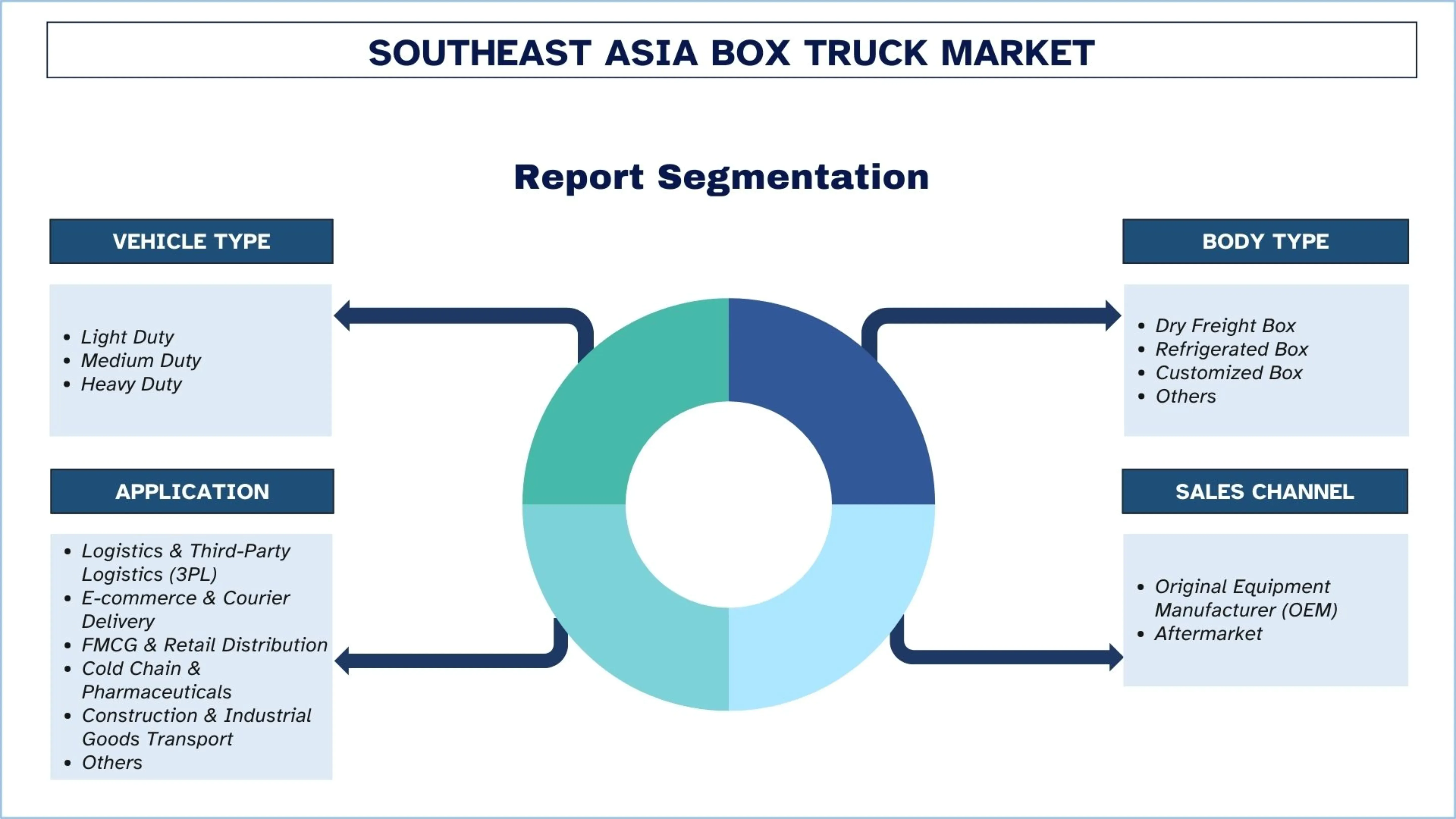
Emphasis on Vehicle Type (Light Duty, Medium Duty, Heavy Duty); Body Type (Dry Freight Box, Refrigerated Box, Customized Box, Others); Application (Logistics & Third-Party Logistics (3PL), E-commerce & Courier Delivery, FMCG & Retail Distribution, Cold Chain & Pharmaceuticals, Construction & Industrial Goods Transport, Others); Fuel Type (Diesel, Petrol, CNG/LPG, Electric, Hybrid); Sales Channel (Original Equipment Manufacturer (OEM), Aftermarket); and Country.
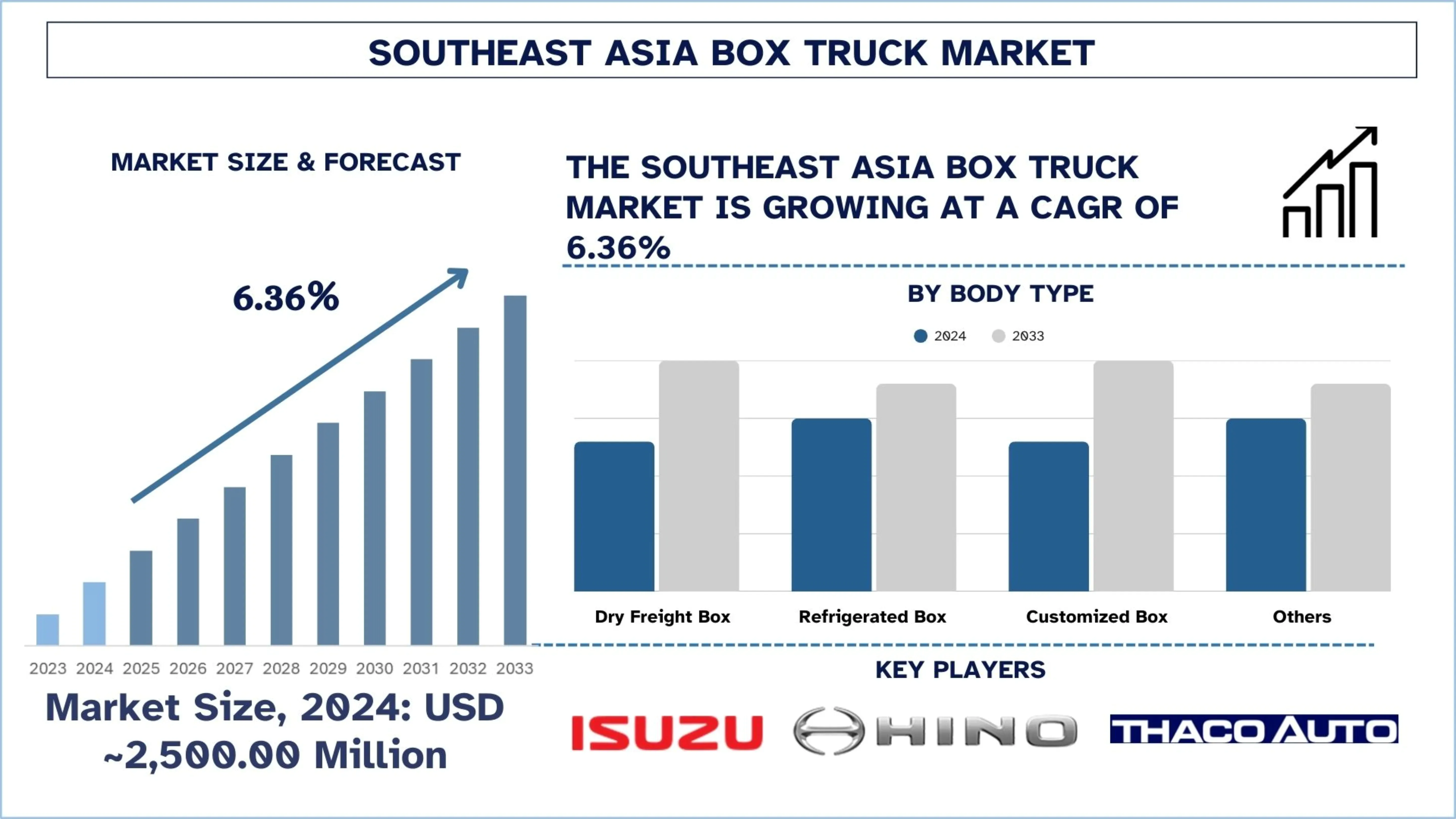
Southeast Asia Box Truck Market Size & Forecast
The Southeast Asia Box Truck Market was valued at ~USD 2,500.00 million in 2024 and is expected to grow at a strong CAGR of approximately 6.36% during the forecast period (2025-2033F), driven by the expansion of cold chain logistics for food and pharmaceuticals.
Southeast Asia Box Truck Market Analysis
Box trucks are commercial vehicles that are light-, medium-, or heavy-weight in nature and are designed so as to have a fully enclosed cargo compartment mounted on the vehicle frame. They are commonly used to carry out last-mile delivery, cold chain logistics, FMCG logistics, and industrial logistics.
In Southeast Asia, manufacturers and fleet operators are adopting localized assembly, modular body customization, and telematics integration to improve operational efficiency and shorten delivery lead times. Additionally, companies are moving towards refrigerated setups to facilitate the growth of cold chains and are also launching fuel- and electric-powered versions for urban logistics. Also, the accessibility of SMEs is enhanced through strategic partnerships with logistics companies, financing organizations, and body builders, and this is also boosting the fast-tracked expansion of structured fleets. Furthermore, the implementation of digital fleet management systems aims to balance route optimization, fuel consumption, and vehicle availability, thereby supporting long-term profitability and market penetration.
For instance, on April 24, 2025, the Hino Group in Thailand, comprising Hino Motors Sales (Thailand) Ltd., Hino Motors Manufacturing (Thailand) Ltd., and Hino Motors Asia Ltd., officially launched the new “HINO EURO 5” truck at Hino Suvarnabhumi Plant. The launch reflects Hino’s commitment to supporting transport businesses nationwide with professional-grade vehicles and services under the concept “Always Your Professionals.”
Southeast Asia Box Truck Market Trends
This section discusses the key market trends that are influencing the various segments of the Southeast Asia Box Truck market, as found by our team of research experts.
Adoption of Connected Fleet Management Systems
The Southeast Asia box truck market experienced growth as operators focus on cost-efficiency and asset optimization. The integration of telematics enables real-time tracking, route optimization, fuel monitoring, and predictive maintenance, which improve fleet utilization rates. Also, the logistics companies are now adopting IoT-based sensors to track driver and cargo behavior, especially for temperature-sensitive deliveries. Adding to this, the digital transformation increases operational transparency and supports data-driven decision-making in large and mid-sized fleets. With growing competition in the last-mile and 3PL segments, the concept of connected fleet platforms is becoming an obligatory feature rather than an add-on service. Moreover, the enhanced highway connectivity and cross-border commerce in Southeast Asia are contributing to continued commercial vehicle purchases. For example, on December 4, 2025, GEODIS, a global leader in transport and logistics, announced the launch of Southeast Asia’s first cross-border trucking operation to be powered by Neste MY Renewable Diesel, marking a major milestone in the decarbonization of its regional road network. The pilot features a dedicated Euro-5 truck travelling from Singapore to the Thailand-Malaysia border using renewable diesel supplied by Neste.
Southeast Asia Box Truck Industry Segmentation
This section provides an analysis of the key trends in each segment of the Southeast Asia Box Truck market, along with forecasts at the country level for 2025-2033.
The light-duty Truck market held the dominant share of the Box Truck market in 2024.
Based on vehicle type, the market is segmented into light duty, medium duty, and heavy duty. Among these, the light-duty box truck market held the largest share in 2024. This is because of the suitability of the last-mile and intra-city transportation. The increased e-commerce penetration and the concentration of urban infrastructure in Indonesia, Vietnam, and Thailand are driving the need to develop smaller, fuel-efficient cargo vehicles. This segment stimulates increased fleet turnover and volume sales, especially SMEs and new operators in the logistics industry. For instance, on September 25, 2024, Mitsubishi Fuso Truck and Bus Corporation officially launched its all-electric light-duty eCanter truck in Singapore and handed over the first unit to a local customer.
The refrigerated box truck market is expected to grow at a significant CAGR during the forecast period (2025-2033).
Based on body type, the Southeast Asian Box Truck market is segmented into dry freight box, refrigerated box, customized box, and others. Among these, the refrigerated box truck market is expected to grow at a significant CAGR during the forecast period (2025-2033) by boosting demand for cold chain logistics in food, seafood exports, dairy, and pharmaceuticals. Also, the governments and non-governmental organizations are investing in a temperature-controlled supply chain, establishing long-term acquisition of reefer-enabled fleets. This segment helps to maintain higher prices and margin-enhancing OEM and body-builder revenues. For example, on August 1, 2025, as part of the Vietnam International Logistics Exhibition 2025, Isuzu Vietnam Co., Ltd. (Isuzu Vietnam) collaborated with Quyen Auto, a body-building company, to introduce the new specialized pickup for urban cold cargo transport – ISUZU D-MAX UTZ Frozen Box.
Indonesia held a dominant share of the Southeast Asian Box Truck market in 2024
Indonesia held the largest share of the Southeast Asian box truck market, as it has a growing e-commerce ecosystem and a geographically dispersed archipelagic (one or more groups of islands) logistics framework. The rapid increase in last-mile delivery in Tier-1 and Tier-2 urban areas is driving demand for light- and medium-duty box trucks. Also, the competitive pricing and availability of fleets are supported by the high domestic manufacturing base in the country, especially the commercial vehicle assembly operations. Adding to this, the adoption of refrigerated box trucks is being enhanced by the development of cold chains for seafood, pharmaceuticals, and processed foods. Moreover, the development of government infrastructure and logistics corridors is enhancing inter-island freight movement, which supports long-term fleet demand and drives the market growth. For example, on February 10, 2026, PT Tata Motors Distribusi Indonesia, a wholly owned indirect subsidiary of Tata Motors Limited, informed that it has entered into an agreement for the supply of 70,000 vehicles for deployment in Indonesia. The vehicles will be used to support agricultural activities and rural logistics, including farm-to-market transportation and regional goods movement across the country. Tata Motors will support with the supply of 35,000 units each of the Yodha (pick-up) and the Ultra T.7 (truck), to its subsidiary PT Tata Motors Distribusi Indonesia.
Southeast Asia Box Truck Industry Competitive Landscape
The Southeast Asia Box Truck market is competitive, with several global and international market players. The key players are adopting different growth strategies to enhance their market presence, such as partnerships, agreements, collaborations, new product launches, geographical expansions, and mergers and acquisitions.
Top Southeast Asia Box Truck Companies
Some of the major players in the market are ISUZU MOTORS LIMITED, Hino Motors, Ltd. (Toyota Group Company), ALMAZORA MOTORS CORPORATION, Scania, Foton International, Ford Motor Company, PT Daimler Commercial Vehicles Indonesia (Daimler Truck AG), Hyundai Motor Company, FAW TRUCKS CO., LTD., THACO AUTO LLC.
Recent Developments in the Southeast Asia Box Truck Market
On February 3, 2025, at the THACO Chu Lai Industrial Park (Quang Nam), THACO AUTO held the inauguration ceremony of production technology at the THACO Bus Plant and launched new product lines of the THACO Bus and THACO Truck brands. Simultaneously, THACO AUTO completed the lineup of THACO Truck with versions ranging from 1.5 tons to 14 tons, and cabin sizes from 1,735 to 2,250 mm.
On February 16, 2024, Nippon Express Logistics (Thailand) Co., Ltd., a group company of NIPPON EXPRESS HOLDINGS, INC., introduced its first EV truck that emits no CO2 or pollutants while on the road as part of its efforts to address climate change.
Southeast Asia Box Truck Market Report Coverage
Details | |
Base year | 2024 |
Forecast period | 2025-2033 |
Growth momentum | Accelerate at a CAGR of 6.36% |
Market size 2024 | ~USD 2,500.00 million |
Country analysis | Indonesia, Thailand, Philippines, Vietnam, Malaysia, Singapore, Rest of Southeast Asia |
Major contributing Country | Vietnam is expected to grow at the highest CAGR during the forecasted period. |
Companies profiled | ISUZU MOTORS LIMITED, Hino Motors, Ltd. (Toyota Group Company), ALMAZORA MOTORS CORPORATION, Scania, Foton International, Ford Motor Company, PT Daimler Commercial Vehicles Indonesia (Daimler Truck AG), Hyundai Motor Company, FAW TRUCKS CO., LTD., THACO AUTO LLC. |
Report Scope | Market Trends, Drivers, and Restraints; Revenue Estimation and Forecast; Segmentation Analysis; Demand and Supply Side Analysis; Competitive Landscape; Company Profiling |
Segments Covered | By Vehicle Type, By Body Type, By Application, By Fuel Type, By Sales Channel, By Country |
Reasons to Buy the Southeast Asia Box Truck Market Report:
The study includes market sizing and forecasting analysis confirmed by authenticated key industry experts.
The report briefly reviews overall industry performance at a glance.
The report covers an in-depth analysis of prominent industry peers, primarily focusing on key business financials, product portfolios, expansion strategies, and recent developments.
Detailed examination of drivers, restraints, key trends, and opportunities prevailing in the industry.
The study comprehensively covers the market across different segments.
Customization Options:
The Southeast Asia Box Truck Market can further be customized as per requirements or any other market segment. Besides this, UnivDatos understands that you may have your own business needs; hence, feel free to contact us to get a report that completely suits your requirements.
Table of Content
Research Methodology for the Southeast Asia Box Truck Market Analysis (2023-2033)
We analyzed the historical market, estimated the current market, and forecasted the future market of the Southeast Asian Box Truck market to assess its application in major countries. We conducted exhaustive secondary research to gather historical market data and estimate the current market size. To validate these insights, we carefully reviewed numerous findings and assumptions. Additionally, we conducted in-depth primary interviews with industry experts across the Southeast Asian Box Truck value chain. After validating market figures through these interviews, we used both top-down and bottom-up approaches to forecast the overall market size. We then employed market breakdown and data triangulation methods to estimate and analyze the market size of industry segments and sub-segments.
Market Engineering
We employed the data triangulation technique to finalize the overall market estimation and derive precise statistical numbers for each segment and sub-segment of the Southeast Asia Box Truck market. We split the data into several segments and sub-segments by analyzing various parameters and trends, including vehicle type, body type, application, fuel type, sales channel, and country within the Southeast Asian Box Truck market.
The Main Objective of the Southeast Asia Box Truck Market Study
The study identifies current and future trends in the Southeast Asia Box Truck market, providing strategic insights for investors. It highlights market attractiveness, enabling industry participants to tap into untapped markets and gain a first-mover advantage. Other quantitative goals of the studies include:
Market Size Analysis: Assess the current and forecast market size of the Southeast Asia Box Truck market and its segments in terms of value (USD).
Southeast Asia Box Truck Market Segmentation: Segments in the study include areas of vehicle type, body type, application, fuel type, sales channel, and country.
Regulatory Framework & Value Chain Analysis: Examine the regulatory framework, value chain, customer behavior, and competitive landscape of the Southeast Asia Box Truck industry.
Country Analysis: Conduct a detailed country analysis for key areas such as Indonesia, Thailand, the Philippines, Vietnam, Malaysia, Singapore, and the Rest of Southeast Asia.
Company Profiles & Growth Strategies: Company profiles of the Southeast Asia Box Truck market and the growth strategies adopted by the market players to sustain the fast-growing market.
Frequently Asked Questions FAQs
Q1: What is the Southeast Asia Box Truck market’s current market size and growth potential?
The Southeast Asia Box Truck market was valued at ~USD 2,500.00 million in 2024 and is projected to expand at a CAGR of 6.36% from 2025 to 2033. Growth is supported by rapid e-commerce expansion, rising third-party logistics (3PL) penetration, infrastructure development, and increasing cold chain investments across the region.
Q2: Which segment has the largest share of the Southeast Asia Box Truck market by Vehicle Type?
Light-duty box trucks dominate the Southeast Asia market, driven by last-mile delivery growth, e-commerce parcel volumes, and urban distribution needs. Their lower acquisition cost, fuel efficiency, and suitability for congested city logistics networks make them the preferred choice for SMEs, courier operators, and FMCG distributors.
Q3: What are the driving factors for the growth of the Southeast Asia Box Truck market?
Market growth is driven by:
• Rapid e-commerce expansion across ASEAN economies
• Growth of organized retail and FMCG distribution
• Expansion of cold chain logistics for pharmaceuticals and perishables.
Q4: What are the emerging technologies and trends in the Southeast Asia Box Truck market?
Key trends include electrification of light-duty fleets, telematics and fleet management integration, temperature-controlled smart box solutions, lightweight body materials for improved payload efficiency, and digital fleet optimization platforms. OEMs are also expanding CKD assembly and localized manufacturing to reduce costs and improve supply chain resilience.
Q5: What are the key challenges in the Southeast Asia Box Truck market?
Key challenges include fluctuating raw material costs, tightening emission regulations, high upfront costs of electric trucks, limited EV charging infrastructure, financing constraints for small fleet operators, and intense price competition from Chinese OEM imports.
Q6: Which country dominates the Southeast Asia Box Truck market?
Indonesia dominates the regional market due to its large domestic consumption base, expanding logistics sector, strong presence of Japanese OEM manufacturing facilities, and government-led infrastructure investments supporting commercial vehicle demand.
Q7: Who are the key players in the Southeast Asia Box Truck market?
Leading companies in the Southeast Asia Box Truck market include:
• ISUZU MOTORS LIMITED
• Hino Motors, Ltd. (Toyota Group Company)
• ALMAZORA MOTORS CORPORATION
• Scania
• Foton International
• Ford Motor Company
• PT Daimler Commercial Vehicles Indonesia (Daimler Truck AG)
• Hyundai Motor Company
• FAW TRUCKS CO., LTD.
• THACO AUTO LLC
Q8: What investment opportunities exist in the Southeast Asia Box Truck market?
High-growth opportunities exist in electric light-duty trucks, refrigerated box solutions for cold chain logistics, fleet telematics integration, localized CKD assembly, and aftermarket services, including maintenance contracts and financing solutions. Strategic partnerships with regional logistics firms and e-commerce platforms present strong long-term returns.
Q9: How is electrification impacting the Southeast Asia Box Truck market landscape?
Electrification is gaining traction in urban delivery fleets, particularly in Singapore, Thailand, and Indonesia. Government incentives, ESG compliance goals, and rising fuel prices are accelerating EV adoption in light-duty segments. However, charging infrastructure and battery cost remain critical investment considerations.
Related Reports
Customers who bought this item also bought






Freight Railcar Repair Market: Current Analysis and Forecast (2025-2033)
Emphasis on Repair Type (Mechanical (Brake System, Coupler & Draft Gears, Bearing & Axles, Wheels & Wheelsets, Doors & hatches, Pneumatic Systems, Others), Structural (Boday & Frame Repair, Welding & Metalworks, Corrosion Prevention & Repair, Roof, sides & Underbody Repair, Others), Interior (Flooring & Subflooring, Interior Lining & Insulation, Others)); By Service (Mobile, On-Site); and Region/Country
May 9, 2025

Automotive Sprocket Market: Current Analysis and Forecast (2025-2033)
Emphasis on Product Type (Timing Sprockets, Roller Chain Sprockets, Silent Chain Sprockets, and Others); Vehicle Type (Two-Wheelers, Passenger Cars, Light Commercial Vehicles, Heavy Commercial Vehicles, and Electric Vehicles (EVs) & Hybrid Vehicles); Sales Channel (Aftermarket and Original Equipment Manufacturer (OEM)); and Region/Country
May 6, 2025