- Home
- About Us
- Industry
- Services
- Reading
- Contact Us
Codeless Payment Platform Market: Current Analysis and Forecast (2025-2033)
Emphasis on Product Type (Hosted Gateway, Self-hosted Gateway, and Other); Application (Enterprise and Individual); and Region/Country
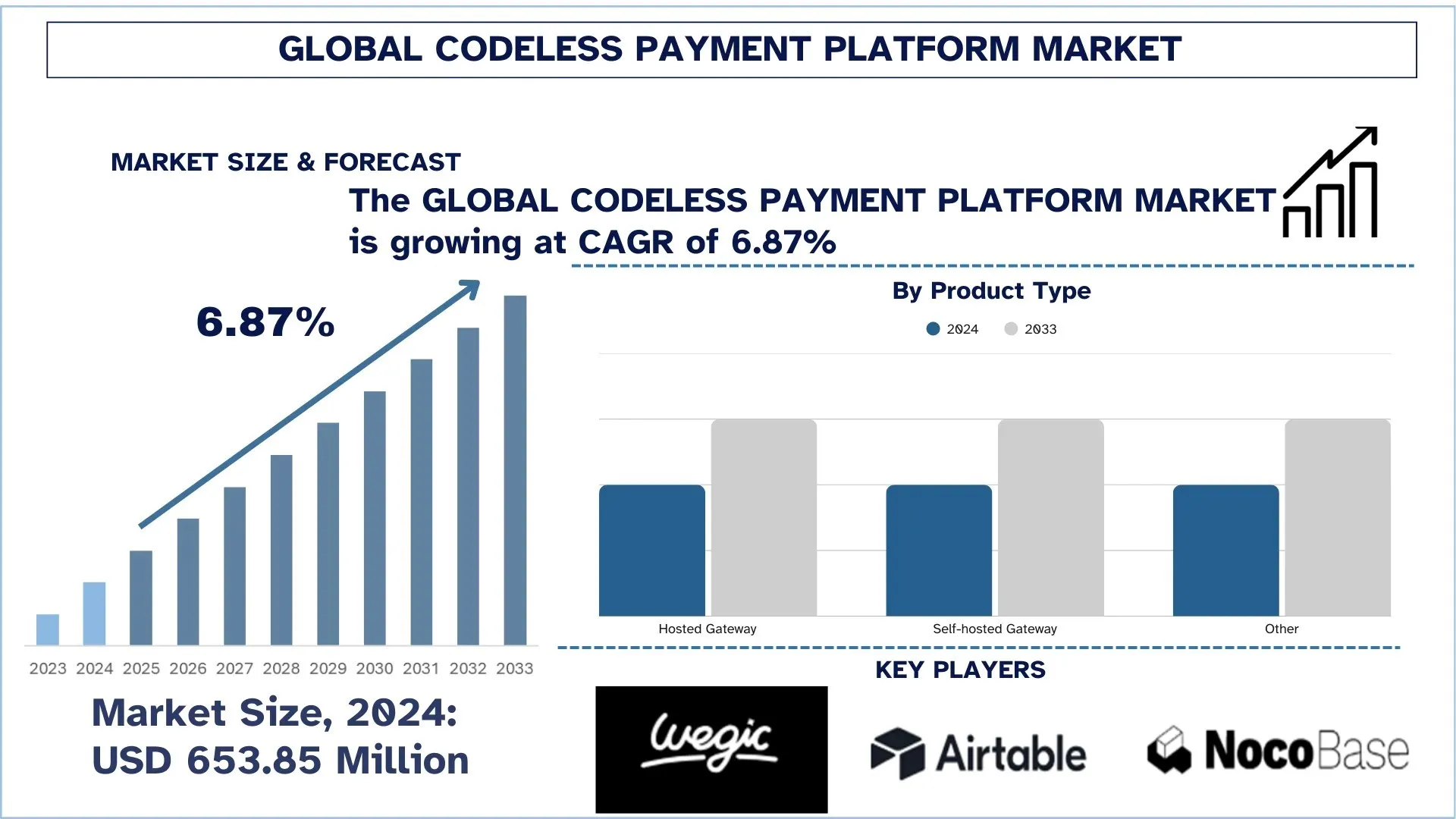
Global Codeless Payment Platform Market Size & Forecast
The Global Codeless Payment Platform Market was valued at USD 653.85 million in 2024 and is expected to grow at a CAGR of around 6.87% during the forecast period (2025–2033F). The rising volume of online and mobile transactions, combined with the rapid expansion of embedded finance and unified commerce across merchants and SaaS platforms, is driving demand for the global codeless payment platform market.
Codeless Payment Platform Market Analysis
Codeless payment systems are increasingly challenging, yet the current reality requires orchestrating transactions with the highest degree of reliability and without disrupting checkout performance across a broad range of channels, territories, currencies, and risk scenarios. Security and compliance demands, stricter economic constraints, and a push toward embedded finance, real-time payments, and unified commerce increasingly drive the market for codeless payment platforms. As a central enabling layer of today's payment stack, these platforms are a major focus for merchants, PSPs, and SaaS vendors, affecting conversion, fraud risk, settlement speed, and overall operating expenses across the industry. It can also be justified by the fact that custom-written integrations were replaced by configurable workflows and API abstraction that leverage tokenization, network rules, and smart routing, enabling scalability, auditability, and shorter time-to-market. The strategic use of the latest risk indicators, identity checks, orchestration rules, and analytics, along with accurate configuration management to manage chargebacks, adapt to changing regulations, and maintain performance continuity during long growth periods, is key to market expansion. Simultaneously, over the last few years, the capability of payment operations to operate effectively with automated reconciliation, AI-assisted fraud control, and an intelligent monitoring system has been emphasized as the omnichannel demands, subscriptions, and growing cross-border and instant-payment applications increasingly require traditional payment architectures to become more resilient, configurable, and evolving.
Global Codeless Payment Platform Market Trends
This section discusses the key market trends that are influencing the various segments of the global codeless payment platform market, as found by our team of research experts.
Expansion Of Drag-And-Drop Toolkits and Automated Workflow Builders
Drag-and-drop toolkits and automated workflow builders are expanding the codeless payment platform market by converting complex payment functions into reusable, visual blocks. Instead of manually coding integrations to gateways, wallets, cards, UPI/ACH rails, taxes, invoicing, KYC, fraud screening, retries, chargebacks, and reconciliation, a team sends flows to a canvas and delivers changes in hours. The workflow builders allow routing transactions by geography, currency, fee, latency, or success rate; fail over to backup providers; and add rules for risk, limits, or subscription proration. They also enhance better governance with templates, role-based approvals, audit logs, and versioning- useful in regulated industries. For SMEs and marketplaces, citizen developers can roll out new checkout experiences, payouts, or partner onboarding without a limited pool of engineers, at lower cost and with shorter time-to-market. Visual automation is the easiest way to maintain payment stacks that are flexible, scalable, and continuously optimized as the number of APIs and compliance requirements grows. The trend drives adoption across retail, SaaS, and fintech ecosystems.
Codeless Payment Platform Industry Segmentation
This section provides an analysis of the key trends in each segment of the global codeless payment platform market report, along with forecasts at the global, regional, and country levels for 2025-2033.
The Hosted Gateway Segment Dominates the Codeless Payment Platform Market
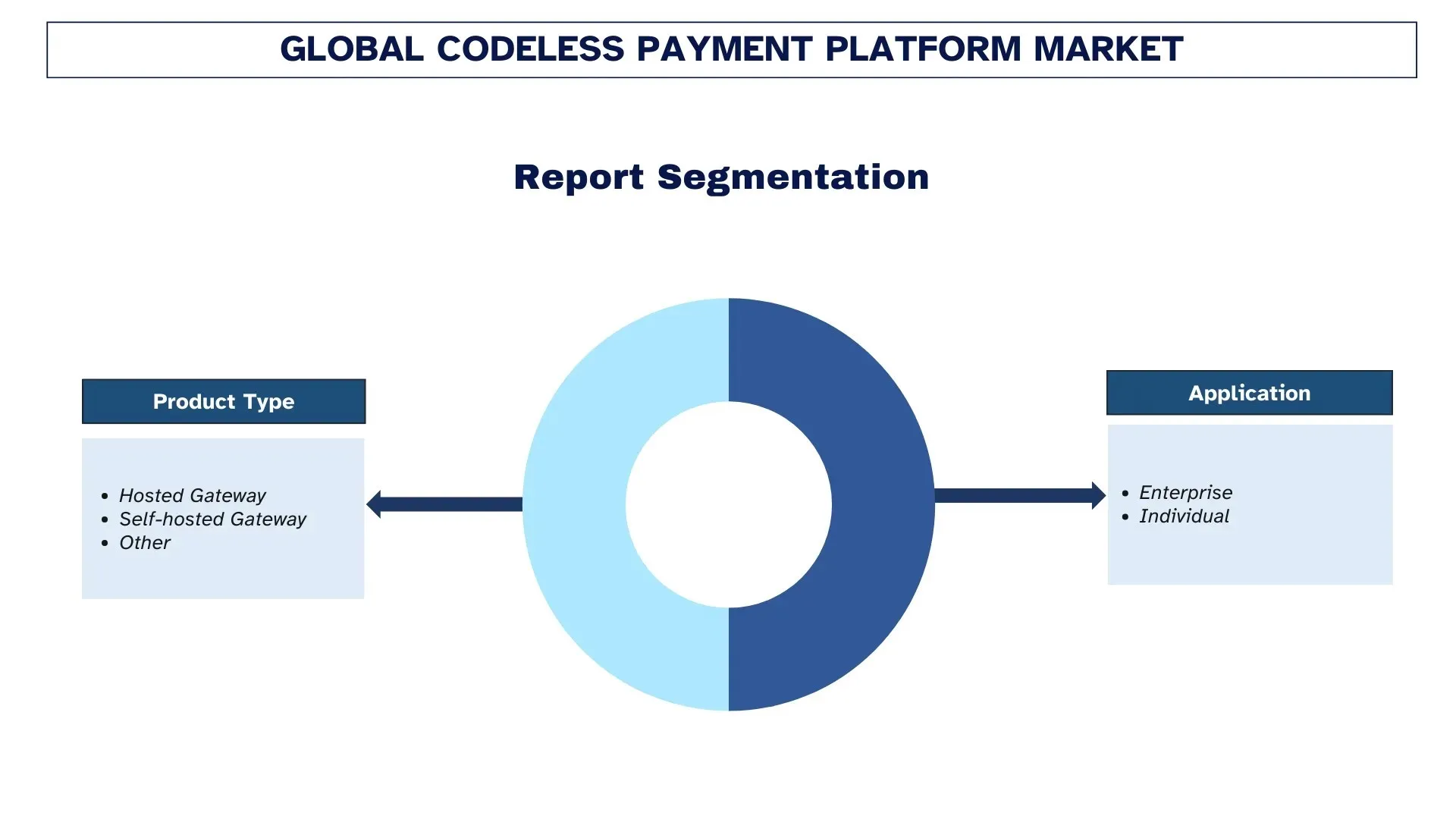
Based on product type, the global codeless payment platform market is segmented into Hosted Gateway, Self-hosted Gateway, and Other. In 2024, the Hosted Gateway segment is projected to hold the largest market share and remain dominant throughout the forecast period. This is because the hosted models fit the most popular mid-market and enterprise use cases in digital commerce that require fast deployments, reduced reliance on engineering, and built-in compliance (e.g., PCI scope reduction), and provide predictable checkout experiences across devices and geographies. Such platforms generally offer pre-certified payment systems, automated updates, tokenization, and risk configurations, allowing merchants, marketplaces, and SaaS providers to manage conversion, security, and operating costs under stricter regulatory and fraud pressures. Self-hosted Gateway, in turn, is expected to grow the fastest as the need for stronger control over the user experience, data disposal, and routing decisions among large retailers, super-apps, and regulated industries increases.
The Enterprise Segment held the Largest Market Share in the Codeless Payment Platform Market.
Based on application, the global codeless payment platform market is segmented into Enterprise and Individual. In 2024, the Enterprise segment is projected to hold the largest market share and remain dominant throughout the forecast period. This is mainly because businesses operate at higher transaction volumes and in more sophisticated environments, across multiple brands, regions, currencies, payment systems, and risk exposures, where codeless orchestration enables faster rollout of new payment options, uniform governance, and measurable increases in authorization rates and conversion. These services typically offer centralized configuration, intelligent routing across PSPs/acquirers, token vaulting, fraud and chargeback tooling, and automated reporting, which make omnichannel checkout more smoothly configured and enable business unit reconciliation and steady operation under increased regulatory and security pressures. The Individual segment is likely to grow the most, driven by creator commerce, adoption by micro-merchants, and mobile-first selling via social and messaging platforms. True onboarding, intuitive no-code links and invoices, built-in wallets, and low-friction pay-in/pay-out are required as transaction volume increases.
North America Dominated the Global Codeless Payment Platform Market
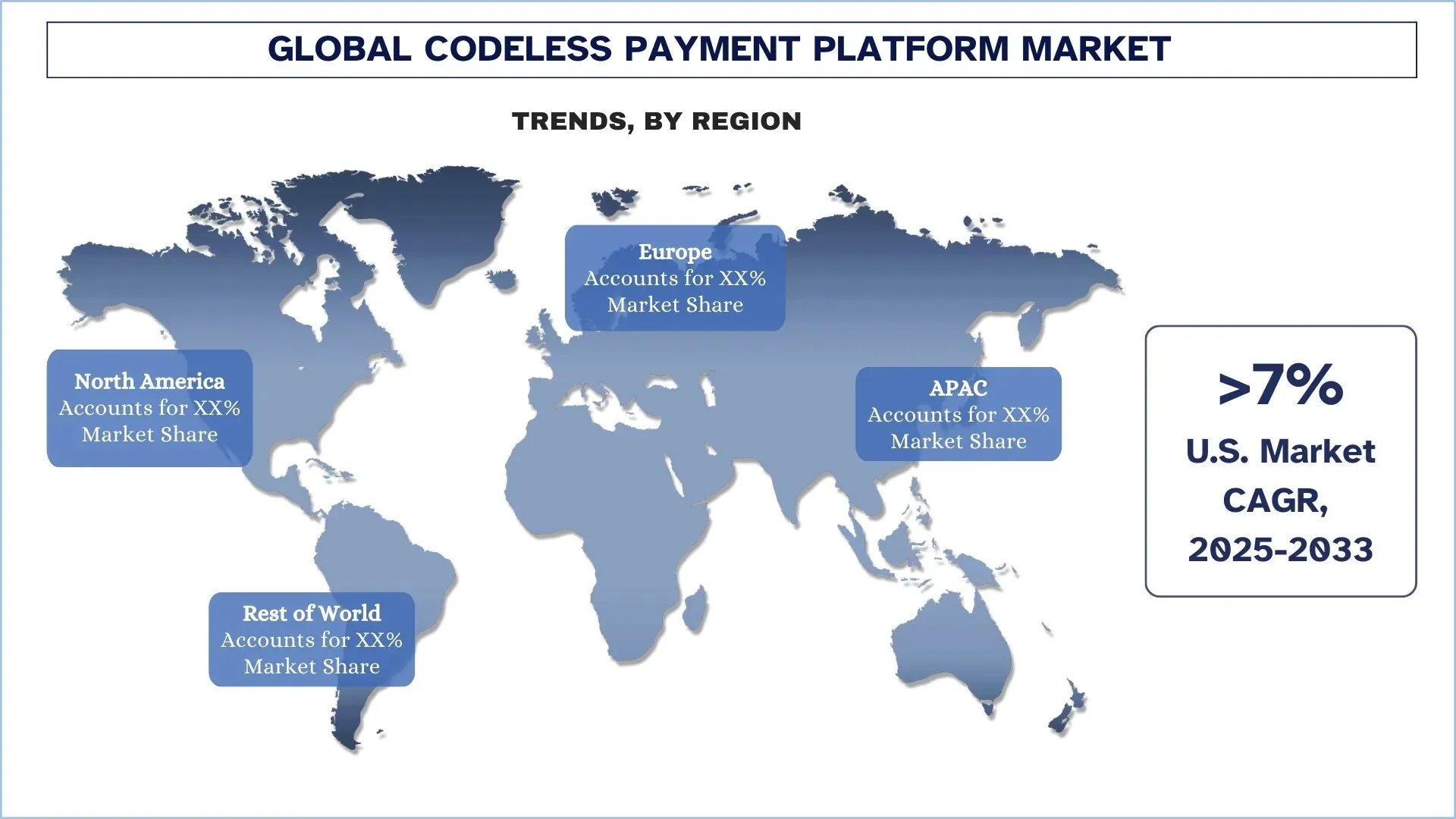
North America dominated the global codeless payment platform market and will likely maintain that position over the forecast period. The existence of a well-developed digital commerce ecosystem, card and wallet saturation, extensive cloud adoption, and the presence of the largest payment processors, fintechs, and SaaS platforms enable the rapid introduction of new payment methods without intensive engineering support. Large companies in the retail sector, the travel sector, subscription service, and marketplaces are also actively investing in payment orchestration, tokenization, and fraud controls, and this creates long-term demand for configurable gateway layers, smart routing, and the provision of a single reporting to enhance the authorization rate and reduce processing costs. As more buyers move toward omnichannel purchasing, compliance and security requirements increase; consequently, more merchants are adopting codeless solutions to unify the checkout process, accelerate cross-border growth, and reduce operational strain in reconciliation and chargeback management. Additionally, the market is growing rapidly as the transition to embedded finance and platform-based payments continues, with payment functionality bundled into software products and deployed at scale.
U.S. held a dominant Share of the North America Codeless Payment Platform Market in 2024
The US is the market leader in the codeless payment platform, and the most significant digital commerce opportunity in the world has been aligned with the most profound payment and fintech ecosystem. The size of U.S. retail e-commerce is growing. U.S. Census Bureau statistics estimate e-commerce sales of 352.9 billion in Q4 2024, which constitutes 17.9 percent of total retail sales, making it a colossal transaction base that accelerates the adoption of enterprise orchestration and the demand for a middle-market platform. This trend is also facilitated by the mobile-first checkout experience: Adobe estimated USD 241.4 billion of online holiday sales in the US (Nov-Dec 2024), with 54.5 percent of the sum of which is to be made on mobile devices, contributing to the significance of quick and customized checkout optimization. The established norms of compliance and risk management, based on PCI, prompt merchants to adopt tokenization, hosted components, and workflow controllers to reduce exposure without affecting performance.
Codeless Payment Platform Industry Competitive Landscape
The global codeless payment platform market is competitive, with several global and international market players. The key players are adopting different growth strategies to enhance their market presence, such as partnerships, agreements, collaborations, new product launches, geographical expansions, and mergers and acquisitions.
Top Codeless Payment Platform Companies
Some of the major players in the market are Wegic, Airtable, NocoBase, Bubble Group, Inc., Adalo, Webflow, Inc., Stripe, Inc., Airwallex, and UseePay.
Recent Developments in the Codeless Payment Platform Market
In October 2025, Spacelift introduced Spacelift Intent, an open-source, agentic natural-language model for cloud infrastructure provisioning that removes the need to write HCL or Terraform code. Developers can request resources in plain language for instant provisioning, while platform teams retain policy enforcement, visibility, and audit trails through Spacelift’s orchestration platform. Built on Terraform providers, Intent complements IaC/GitOps for fast, governed, low-ceremony deployments workflows
In July 2025, Payara and Azul declared a strategic combination to provide an integrated Java deployment and codeless lift-and-shift move choice to controlled industries. The bundle will include Payara Qube automated, pre-configured Kubernetes platforms that are observable and controls that are compliance-ready in combination with a high-performance JVM runtime provided by Azul Platform Prime. The companies claim that customers can modernize without having to write code, ease the management of deployments of hybrid and multi-cloud estates, and save on infrastructure and cloud expenses, as well as enhance the speed, consistency, scalability, and reliability of Java and other JVM-based workloads.
Global Codeless Payment Platform Market Report Coverage
Report Attribute | Details |
Base year | 2024 |
Forecast period | 2025-2033 |
Growth momentum | Accelerate at a CAGR of 6.87% |
Market size 2024 | USD 653.85 Million |
Regional analysis | North America, Europe, APAC, Rest of the World |
Major contributing region | North America is expected to dominate the market during the forecast period. |
Key countries covered | U.S., Canada, Germany, U.K., Spain, Italy, France, China, Japan, and India |
Companies profiled | Wegic, Airtable, NocoBase, Bubble Group, Inc., Adalo, Webflow, Inc., Stripe, Inc., Airwallex, and UseePay |
Report Scope | Market Trends, Drivers, and Restraints; Revenue Estimation and Forecast; Segmentation Analysis; Demand and Supply Side Analysis; Competitive Landscape; Company Profiling |
Segments Covered | By Product Type; By Application, and By Region/Country |
Reasons to Buy the Codeless Payment Platform Market Report:
The study includes market sizing and forecasting analysis confirmed by authenticated key industry experts.
The report briefly reviews overall industry performance at a glance.
The report covers an in-depth analysis of prominent industry peers, primarily focusing on key business financials, type portfolios, expansion strategies, and recent developments.
Detailed examination of drivers, restraints, key trends, and opportunities prevailing in the industry.
The study comprehensively covers the market across different segments.
Deep dive regional-level analysis of the industry.
Customization Options:
The global codeless payment platform market can further be customized as per the requirements or any other market segment. Besides this, UnivDatos understands that you may have your own business needs; hence, feel free to contact us to get a report that completely suits your requirements.
Table of Content
Research Methodology for the Global Codeless Payment Platform Market Analysis (2023-2033)
We analyzed the historical market, estimated the current market, and forecasted the future market of the global codeless payment platform market to assess its application in major regions worldwide. We conducted exhaustive secondary research to gather historical market data and estimate the current market size. To validate these insights, we carefully reviewed numerous findings and assumptions. Additionally, we conducted in-depth primary interviews with industry experts across the codeless payment platform value chain. After validating market figures through these interviews, we used both top-down and bottom-up approaches to forecast the overall market size. We then employed market breakdown and data triangulation methods to estimate and analyze the market size of industry segments and sub-segments.
Market Engineering
We employed the data triangulation technique to finalize the overall market estimation and derive precise statistical numbers for each segment and sub-segment of the global codeless payment platform market. We split the data into several segments and sub-segments by analyzing various parameters and trends, including product type, application, and regions within the global codeless payment platform market.
The Main Objective of the Global Codeless Payment Platform Market Study
The study identifies current and future trends in the global codeless payment platform market, providing strategic insights for investors. It highlights regional market attractiveness, enabling industry participants to tap into untapped markets and gain a first-mover advantage. Other quantitative goals of the studies include:
Market Size Analysis: Assess the current market size and forecast the market size of the global codeless payment platform market and its segments in terms of value (USD).
Codeless Payment Platform Market Segmentation: Segments in the study include areas of product type, application, and regions.
Regulatory Framework & Value Chain Analysis: Examine the regulatory framework, value chain, customer behavior, and competitive landscape of the codeless payment platform industry.
Regional Analysis: Conduct a detailed regional analysis for key areas such as Asia Pacific, Europe, North America, and the Rest of the World.
Company Profiles & Growth Strategies: Company profiles of the codeless payment platform market and the growth strategies adopted by the market players to sustain the fast-growing market.
Frequently Asked Questions FAQs
Q1: What is the global codeless payment platform current market size and its growth potential?
The global codeless payment platform market was valued at USD 653.85 million in 2024 and is expected to grow at a CAGR of 6.87% during the forecast period (2025-2033).
Q2: Which segment has the largest share of the global codeless payment platform market by Product Type?
The hosted gateway segment will remain dominant because it enables fast, low-engineering deployments with built-in compliance (e.g., reduced PCI scope) and consistent checkout across devices and regions.
Q3: What are the driving factors for the growth of the global codeless payment platform market?
• Surging Online And Mobile Commerce Volumes
• Demand For Minimal-Engineering Payment Setup
• Growing SME And Startup Adoption Of No-Code/Low-Code Tools
Q4: What are the emerging technologies and trends in the global codeless payment platform market?
• Expansion Of Drag-And-Drop Toolkits and Automated Workflow Builders
• Embedded Payments Inside Software Products
Q5: What are the key challenges in the global codeless payment platform market?
• Security, Fraud, and Compliance Concerns
• Dependence On Third-Party/Hosted Infrastructure
Q6: Which region dominates the global codeless payment platform market?
North America will likely remain the leading market for codeless payment platforms due to its mature digital commerce ecosystem, card and wallet saturation, cloud adoption, and concentration of major processors, fintechs, and SaaS platforms.
Q7: Who are the key players in the global codeless payment platform market?
Some of the key companies include:
• Wegic
• Airtable
• NocoBase
• Bubble Group, Inc.
• Adalo
• Webflow, Inc.
• Stripe, Inc.
• Airwallex
• UseePay
Q8: How do rising digital transaction volumes and omnichannel expansion influence demand for codeless payment platforms globally?
• Higher Volume = Higher Orchestration Need: More online/mobile transactions increase the need for scalable, reliable routing, retries, and failover without heavy engineering.
• Omnichannel Consistency: Expanding across web, app, POS, and marketplaces drives demand for standardized checkout and unified payment logic across channels.
• Optimization Pull-through: Larger payment volumes justify continuous A/B testing, analytics-driven tuning, and rapid rule updates to lift conversion and reduce costs.
Q9: How do security, compliance, and fraud-risk requirements shape platform capabilities and buyer preference?
• Compliance-by-Design: PCI scope reduction, tokenization, and audit logs favor hosted, governed workflows over custom code.
• Risk Controls at Speed: Real-time risk signals, identity checks, and rules-based controls must be configurable quickly as fraud patterns evolve.
• Governance & Traceability: Role-based access, approvals, and versioning become critical for regulated industries and large teams managing change safely.
Related Reports
Customers who bought this item also bought




Indoor 5G Market: Current Analysis and Forecast (2025-2033)
Emphasis on Technology (Massive MIMO, Small Cell, and Distributed Antenna System (DAS)); Frequency Band (Below 6 GHz and mmWave); End-User (Enterprise (Commercial Buildings, Manufacturing Units, etc)), Public Venues (Stadiums, Airports, etc.), Residential Buildings, Healthcare, and Education); and Region/Country
May 19, 2025

Certificate Authority Market: Current Analysis and Forecast (2025-2033)
Emphasis on Component (Certificate Type, SSL Certificates, Code Signing Certificates, Secure Email Certificates, Authentication Certificates, Services); Certificate Validation Type (Domain Validation, Organization Validation, and Extended Validation); Enterprise Size (SMEs and Large Enterprises); Vertical (BFSI, Retail and E-commerce, Government and Defence, Healthcare, IT and Telecom, Travel and Hospitality, Education, and Others); and Region/Country
May 7, 2025

Digital Thread Market: Current Analysis and Forecast (2025-2033)
Emphasis on Technology (Application Lifecycle Management (ALM), Computer-Aided Design (CAD), Computer-Aided Manufacturing (CAM), Edge Computing, Enterprise Resource Planning (ERP), Industrial Communication, Industrial Sensor, SCADA, Service Lifecycle Management (SLM), and Others); Type of Module (Analytics & Visualization, Connectivity & Interoperability, Data Collection, and Data Management & Integration); Type of Deployment (Cloud Based and On-Premises); Application (Customer Support, Design & Engineering, Distribution, Maintenance & Services, and Others); End-Users (Aerospace, Automotive, Chemicals, Consumer Goods, Energy & Power, Food & Beverages, and Others); and Region/Country
May 6, 2025