- Home
- About Us
- Industry
- Services
- Reading
- Contact Us
Lauramine Oxide Market: Current Analysis and Forecast (2025-2033)
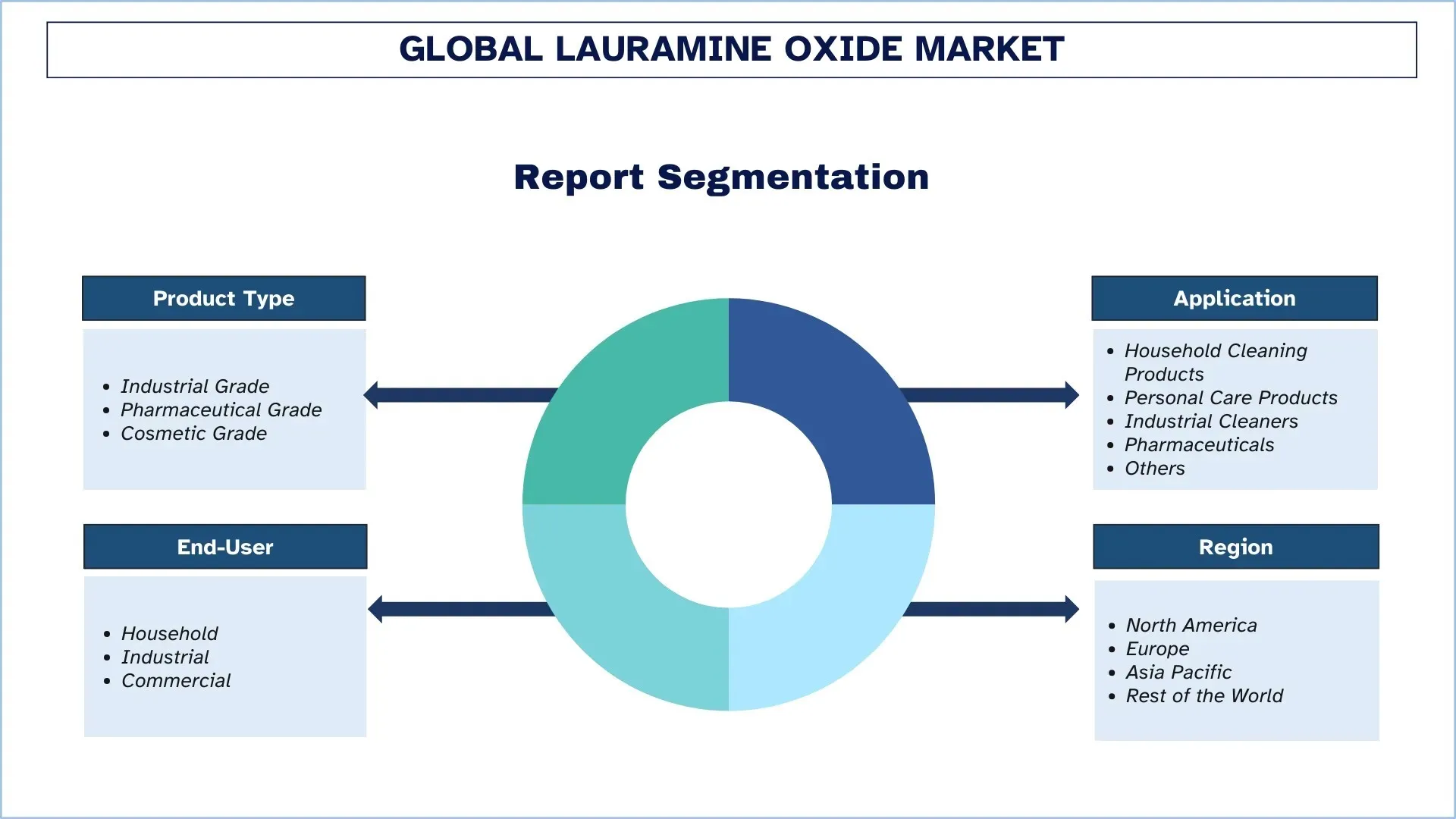
Emphasis on Product Type (Industrial Grade, Pharmaceutical Grade, and Cosmetic Grade); Application (Household Cleaning Products, Personal Care Products, Industrial Cleaners, Pharmaceuticals, and Others); End-User (Household, Industrial, and Commercial); and Region/Country
Global Lauramine Oxide Market Size & Forecast
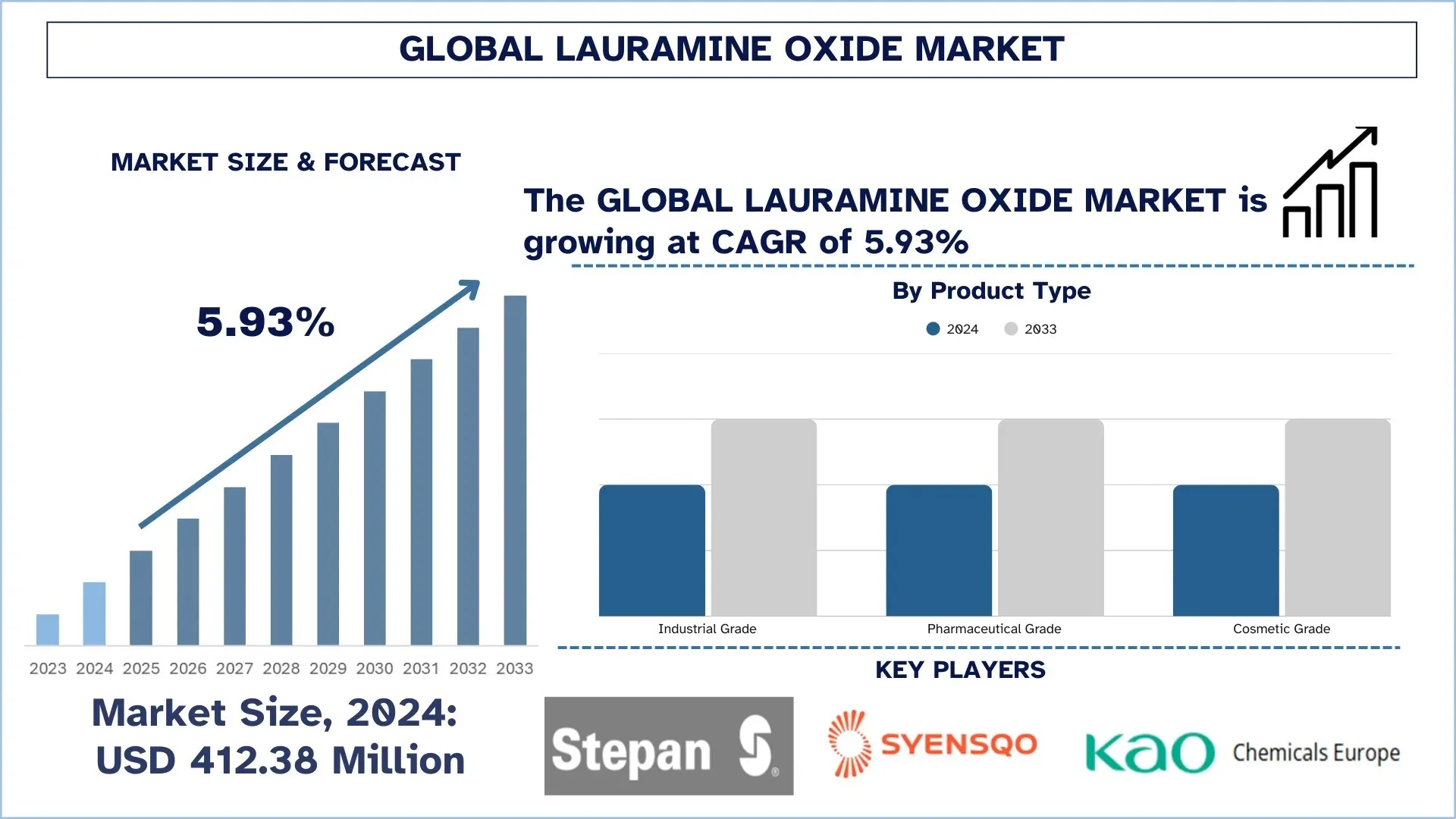
The Global Lauramine Oxide Market was valued at USD 412.38 million in 2024 and is expected to grow at a CAGR of around 5.93% during the forecast period (2025–2033F), driven by the rising demand for high-performance amine oxide surfactants in home care, industrial cleaning and personal care formulations, expanding availability through specialty chemical distributors and direct online procurement channels, and increasing focus on sustainable sourcing, responsible commercialization and regulatory compliance are driving growth in the global lauramine oxide market.
Lauramine Oxide Market Analysis
The global market has been recording consistent growth in the lauramine oxide market as the demand for high-performance surfactants applied in cleaning and personal care formulations is bound to increase. As the focus on hygiene, convenience, and product performance grows, formulators are turning to ingredients to improve foaming, stability, and viscosity in their daily liquid products, and lauramine oxide has become a favored ingredient. It is also popular as a co-surfactant, enhancing foam quality, stability, and thickening while contributing to a deeper user experience in dishwashing liquids, surface cleaners, hand washes, shampoos, and body washes. The market has also been supported by changing consumer preferences for convenient liquid forms, the availability of formulations that feel better, and increasing institutional and commercial cleaning demands. With growing demand, manufacturers are providing higher-grade products with more uniform active content and stronger odor and color control to support mass-market and high-end formulations. Also, lauramine oxide aligns with the realities of on-the-go life by providing convenient, ready-to-clean attachments and personal care products that are easy to carry and use at home, at work, and in social settings.
Global Lauramine Oxide Market Trends
This section discusses the key market trends that are influencing the various segments of the global lauramine oxide market, as found by our team of research experts.
Shifting Toward Gentle/Sulfate-Reduced Formulas
The shift to gentle/sulfate-reduced formulas is a significant trend influencing the lauramine oxide market, with personal care brands and certain home care products positioning their products as gentle, skin-friendly, and sulfate-reduced or sulfate-free. To maintain important performance characteristics of rich lather, creamy foam feel, and acceptable viscosity, as formulators lower or substitute highly foaming anionic surfactants, they must also utilize co-surfactants to support these properties without reducing mildness. Lauramine oxide also performs well in these redesigned surfactant systems, enhancing foam stability and sensory feel while complementing cleansing efficacy when combined with other amphoteric or nonionic ingredients. Premiumization in the shampoos, hand washes, and body washes also supports this trend, with consumers seeking mildness and a good foam experience. Consequently, demand is shifting toward more stable, higher-specification lauramine oxide grades that are now reliable in current gentle formulations.
Lauramine Oxide Industry Segmentation
This section provides an analysis of the key trends in each segment of the global lauramine oxide market report, along with forecasts at the global, regional, and country levels for 2025-2033.
The Industrial Grade Segment Dominates the Lauramine Oxide Market
Based on product type, the global lauramine oxide market is segmented into Industrial Grade, Pharmaceutical Grade, and Cosmetic Grade. In 2024, the Industrial Grade segment is expected to hold the largest market share and maintain its dominance throughout the forecast period. This is primarily because industrial-grade lauramine oxide is used in large quantities in household and industrial cleaning formulations, where it is considered a foam enhancer and viscosity builder that improves cleaning performance and the end-user experience (foam profile, stability, and product thickness). Furthermore, large-volume formulators are very keen on industrial-grade materials, which offer them predictable functionality at a cost-effective price and are easily available through known surfactant distribution networks. The Cosmetic Grade category will continue to expand substantially as regulatory requirements on odor, color, and impurity content for personal care brands increase to meet high-end sensorial profiles and lot-to-lot quality standards for shampoos, body washes, hand washes, and face cleaners.
The Household Cleaning Products Segment held the Largest Market Share in the Lauramine Oxide Market.
Based on application, the global lauramine oxide market is segmented into Household Cleaning Products, Personal Care Products, Industrial Cleaners, Pharmaceuticals, and Others. In 2024, Household Cleaning Products are anticipated to hold the largest market share and continue their dominance throughout the forecast period. This is informed by the high-performance contribution of the ingredient to dishwashing liquids, hard-surface cleaners, and multi-purpose cleaners, especially in enhancing foam, maintaining formulations, and enhancing viscosity to enhance consumer-perceived performance. The Personal Care Products division will also continue to grow steadily as lauramine oxide is an important surfactant and cleansing agent in rinse-off products where the preference is toward mildness and foam, and where lauramine oxide is used to optimize the functionality of anionic surfactants. The durable demand of Industrial Cleaners will be boosted because the institutions and factories will focus on the degreasing and hygiene performance, and the versatility of the ingredient as a building block functional surfactant will help them. The Pharmaceuticals and Others segments are smaller proportions, although they have the capacity to generate incremental growth due to the specialized formulations and greater specification needs.
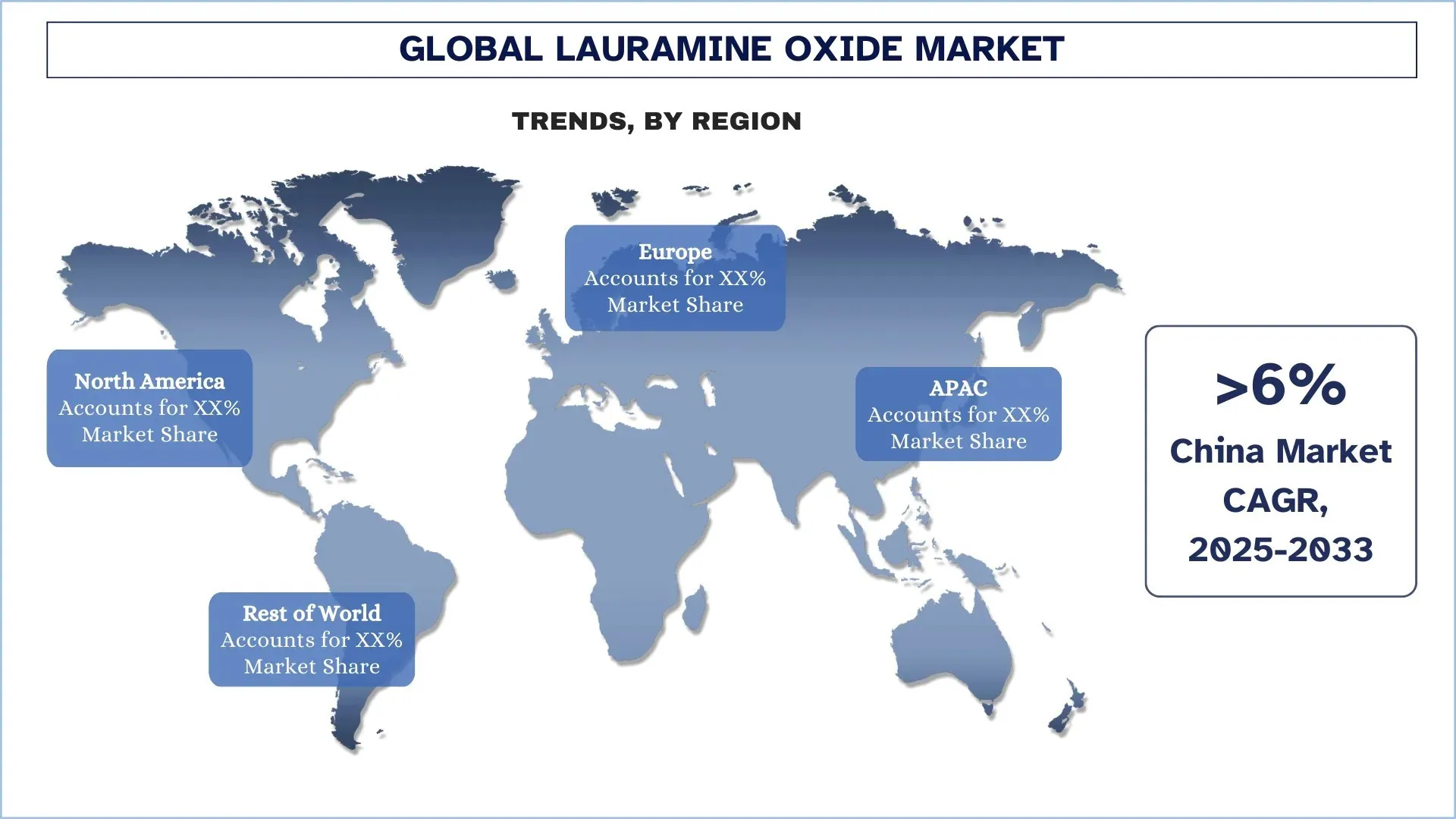
Asia Pacific Dominated the Global Lauramine Oxide Market
Asia-Pacific region is expected to capture the largest market share and remain the dominant region over the forecast period, owing to a large base of home and personal care manufacturing, strong downstream surfactant consumption, and rising demand for middle-class packaged cleaning and hygiene products. The general surfactants market analysis consistently indicates that the Asia-Pacific region is the largest market, underscoring the region's continued significance in demand for lauramine oxide, given its primary use in household and personal care preparations. Moreover, the availability of large oleochemical and surfactant manufacturing centers in countries such as China, India, and Southeast Asia has contributed to more affordable supply and expedited turnaround times for regional formulators. The continued growth of contemporary retailing and online shopping platforms also accelerates the rate of product infiltration and repeat buying of household and personal care products, indirectly boosting the consumption of lauramine oxide throughout the region.
China held a dominant Share of the Asia Pacific Lauramine Oxide Market in 2024
The Chinese success in the lauramine oxide industry is attributable to a large domestic home and personal care manufacturing base and the rapid growth of surfactant and specialty chemical manufacturing. The country also has numerous detergent, personal care, and institutional cleaning formulators, which is another reason why lauramine oxide, as a foam booster and viscosity builder, is needed in liquid cleaning and rinse-off products. It is also supported by increasing urbanization and consumption of packaged hygiene and cleaning products, in which a consistent lather and stable thickness are the most critical consumer expectations. The extensive penetration of interwoven chemical supply chains, low-cost production, and extensive domestic distribution have made China a primary source of regional consumption and international supply. Furthermore, the emphasis on higher-quality formulations is prompting suppliers to adopt stricter specifications (odor/color control and constant active content), thereby enhancing China's position in the global lauramine oxide market.
Lauramine Oxide Industry Competitive Landscape
The global lauramine oxide market is competitive, with several global and international market players. The key players are adopting different growth strategies to enhance their market presence, such as partnerships, agreements, collaborations, new product launches, geographical expansions, and mergers and acquisitions.
Top Lauramine Oxide Companies
Some of the major players in the market are Stepan Company, Syensqo, Kao Chemicals Europe, S.L.U., Graham Chemical, Ataman Chemicals, Lubrizol, Innospec, Sterling Auxiliaries Private Limited, Alpha Chemicals Private Limited, and Silver Fern Chemical LLC.
Recent Developments in the Lauramine Oxide Market
Based on US export data of lauramine oxide, the level of shipping has increased consistently in the first 8 months of 2025, and the amount shipped is about 10.8 metric tons, with the month of March showing the highest level of shipments (about 1,798 MT) and June recording the lowest level of exports so far (about 1,143 MT).
Global Lauramine Oxide Market Report Coverage
Report Attribute | Details |
Base year | 2024 |
Forecast period | 2025-2033 |
Growth momentum | Accelerate at a CAGR of 5.93% |
Market size 2024 | USD 412.38 Million |
Regional analysis | North America, Europe, APAC, Rest of the World |
Major contributing region | Asia Pacific is expected to dominate the market during the forecast period |
Key countries covered | U.S., Canada, Germany, U.K., Spain, Italy, France, China, Japan, and India |
Companies profiled | Stepan Company, Syensqo, Kao Chemicals Europe, S.L.U., Graham Chemical, Ataman Chemicals, Lubrizol, Innospec, Sterling Auxiliaries Private Limited, Alpha Chemicals Private Limited, and Silver Fern Chemical LLC |
Report Scope | Market Trends, Drivers, and Restraints; Revenue Estimation and Forecast; Segmentation Analysis; Demand and Supply Side Analysis; Competitive Landscape; Company Profiling |
Segments Covered | By Product Type, By Application, By End-User, and By Region/Country |
Reasons to Buy the Lauramine Oxide Market Report:
The study includes market sizing and forecasting analysis confirmed by authenticated key industry experts.
The report briefly reviews overall industry performance at a glance.
The report covers an in-depth analysis of prominent industry peers, primarily focusing on key business financials, type portfolios, expansion strategies, and recent developments.
Detailed examination of drivers, restraints, key trends, and opportunities prevailing in the industry.
The study comprehensively covers the market across different segments.
Deep dive regional-level analysis of the industry.
Customization Options:
The global lauramine oxide market can further be customized as per the requirements or any other market segment. Besides this, UnivDatos understands that you may have your own business needs; hence, feel free to contact us to get a report that completely suits your requirements.
Table of Content
Research Methodology for the Global Lauramine Oxide Market Analysis (2023-2033)
We analyzed the historical market, estimated the current market, and forecasted the future market of the global lauramine oxide market to assess its application in major regions worldwide. We conducted exhaustive secondary research to gather historical market data and estimate the current market size. To validate these insights, we carefully reviewed numerous findings and assumptions. Additionally, we conducted in-depth primary interviews with industry experts across the lauramine oxide value chain. After validating market figures through these interviews, we used both top-down and bottom-up approaches to forecast the overall market size. We then employed market breakdown and data triangulation methods to estimate and analyze the market size of industry segments and sub-segments.
Market Engineering
We employed the data triangulation technique to finalize the overall market estimation and derive precise statistical numbers for each segment and sub-segment of the global lauramine oxide market. We split the data into several segments and sub-segments by analyzing various parameters and trends, including product type, application, end-user, and regions within the global lauramine oxide market.
The Main Objective of the Global Lauramine Oxide Market Study
The study identifies current and future trends in the global lauramine oxide market, providing strategic insights for investors. It highlights regional market attractiveness, enabling industry participants to tap into untapped markets and gain a first-mover advantage. Other quantitative goals of the studies include:
Market Size Analysis: Assess the current market size and forecast the market size of the global lauramine oxide market and its segments in terms of value (USD).
Lauramine Oxide Market Segmentation: Segments in the study include areas of product type, application, end-user, and regions.
Regulatory Framework & Value Chain Analysis: Examine the regulatory framework, value chain, customer behavior, and competitive landscape of the lauramine oxide industry.
Regional Analysis: Conduct a detailed regional analysis for key areas such as Asia Pacific, Europe, North America, and the Rest of the World.
Company Profiles & Growth Strategies: Company profiles of the lauramine oxide market and the growth strategies adopted by the market players to sustain the fast-growing market.
Frequently Asked Questions FAQs
Q1: What is the global lauramine oxide current market size and its growth potential?
The global lauramine oxide market was valued at USD 412.38 million in 2024 and is expected to grow at a CAGR of 5.93% during the forecast period (2025-2033).
Q2: Which segment has the largest share of the global lauramine oxide market by Product Type?
The Industrial Grade segment is expected to hold the largest market share and maintain its dominance throughout the forecast period. This is primarily because industrial-grade lauramine oxide is used in large quantities in household and industrial cleaning formulations.
Q3: What are the driving factors for the growth of the global lauramine oxide market?
• Rising Demand For High-Foam Household Cleaners
• Expanding Use In Rinse-Off Personal Care
• Increasing Adoption Of Liquid/Gel Cleaning Formats
Q4: What are the emerging technologies and trends in the global lauramine oxide market?
• Shifting Toward Gentle/Sulfate-Reduced Formulas
• Growing Use for Institutional Cleaning Products
Q5: What are the key challenges in the global lauramine oxide market?
• Volatile Feedstock Pricing and Supply Swings
• Stringent Compliance and Customer Specifications
Q6: Which region dominates the global lauramine oxide market?
Asia Pacific dominated the market owing to a large base of home and personal care manufacturing, strong downstream surfactant consumption, and rising demand for middle-class packaged cleaning and hygiene products.
Q7: Who are the key players in the global lauramine oxide market?
Some of the key companies include:
• Stepan Company
• Syensqo
• Kao Chemicals Europe, S.L.U.
• Graham Chemical
• Ataman Chemicals
• Lubrizol
• Innospec
• Sterling Auxiliaries Private Limited
• Alpha Chemicals Private Limited
• Silver Fern Chemical LLC
Q8: How are sustainability mandates shaping procurement strategies in the global lauramine oxide market?
• Green Compliance: Rising demand for eco-certified surfactants is influencing sourcing decisions and supplier partnerships.
• Lifecycle Audits: Manufacturers are adopting cradle-to-grave assessments to meet carbon footprint disclosure norms.
• Bio-Based Shift: Preference for renewable feedstocks is accelerating R&D investments in plant-derived alternatives.
Q9: How are regional trade policies influencing competitive dynamics in the lauramine oxide market?
• Tariff Variability: Shifts in import duties and anti-dumping measures are altering cost structures for global players.
• Regulatory Alignment: Harmonization efforts in Asia-Pacific and EU markets are streamlining cross-border compliance.
• Market Access: Bilateral agreements are opening new channels for niche suppliers to penetrate emerging economies.
Related Reports
Customers who bought this item also bought



Polyhydroxyalkanoates Films Market: Current Analysis and Forecast (2025-2033)
Emphasis on Product (Short Chain Length, Medium Chain Length, and Long Chain Length); Production Methods (Sugar fermentation, Vegetable oil fermentation, Heterogeneous waste streams, and Others); Application (Packaging & Food Services, Biomedical, Agriculture, and Others); and Region/Country
May 21, 2025


Emphasis on By Product (Bags, Pouches, Wraps, Sachets, and Others), By End-User (Pharmaceuticals, Cosmetics & Personal Care, Automotive, Food & Beverages, Electrical and Electronics, And Others), and Regions (North America (The US, Canada, Rest of North America), Europe (Germany, The UK, France, Italy, Spain, Rest of the Europe), Asia-pacific (China, Japan, India, Rest of the Asia-pacific), Rest of the World)
May 4, 2025