- Home
- About Us
- Industry
- Services
- Reading
- Contact Us
Middle East & Africa Automotive Upholstery Market: Current Analysis and Forecast (2025-2033)
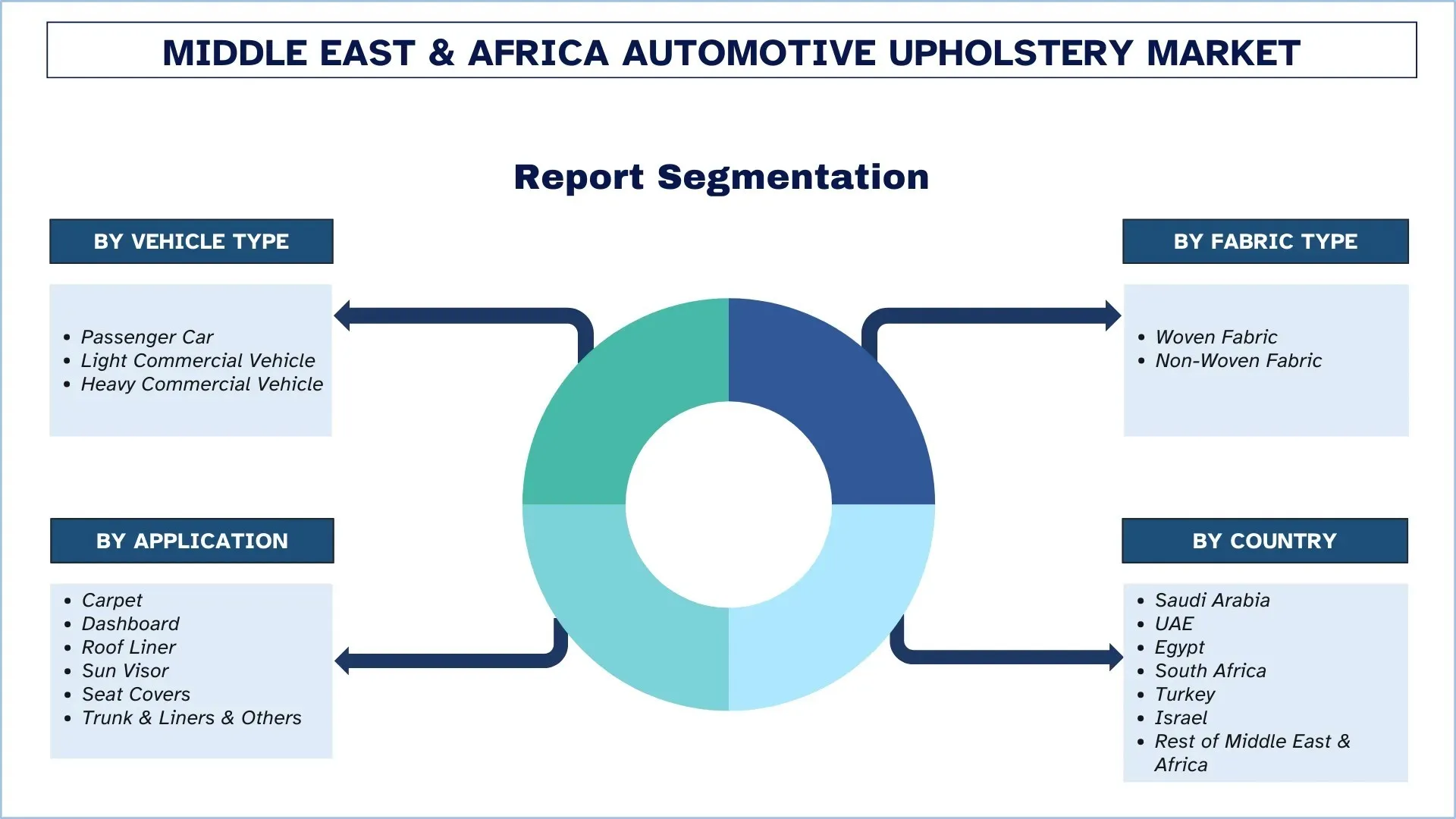
Emphasis By Vehicle Type (Passenger Cars, Light Commercial Vehicles, and Heavy Commercial Vehicles), By Fabric Type (Woven Fabric and Non-Woven Fabric), By Application (Carpet, Dashboard, Roof Liner, Sun Visor, Seat Covers, Trunk Liners & Others), By Country (Saudi Arabia, UAE, Egypt, South Africa, Turkey, Israel, and the Rest of Middle East & Africa)
Middle East & Africa Automotive Upholstery Market Size & Forecast
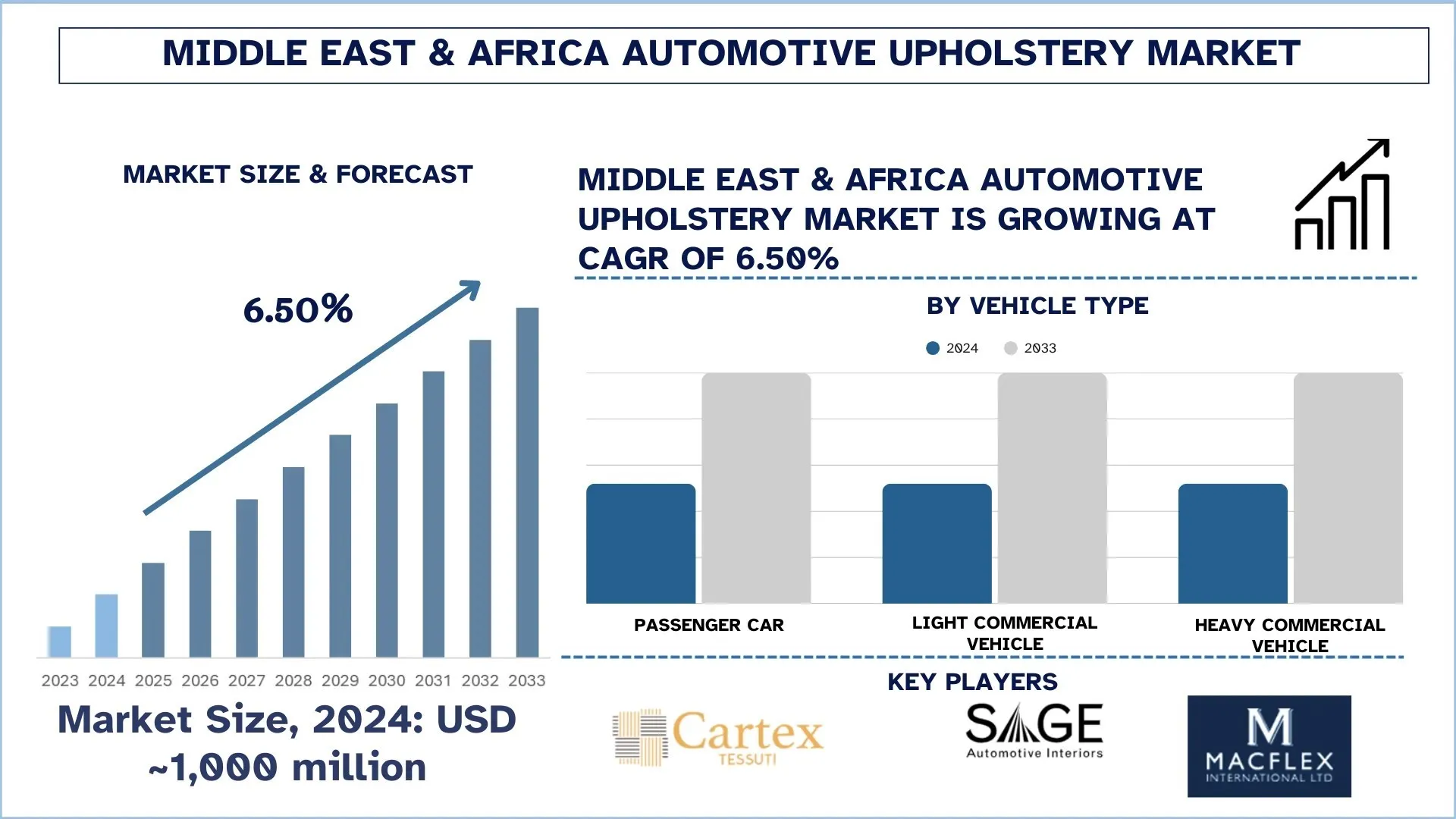
The Middle East & Africa Automotive Upholstery market was valued at USD 1,000 million in 2024 and is expected to grow at a strong CAGR of around 6.50% during the forecast period (2025- 2033F). Growing Sales of SUVs and Premium Vehicles, and Regional OEM/assembly expansion and localization push are some of the factors that have promoted the market rise.
Middle East & Africa Automotive Upholstery Market Analysis
The Middle East & Africa Automotive Upholstery market has experienced notable growth over the years. With the rising demand for leather and synthetic upholstery, a large number of OEMs as well as aftermarket fitment providers have added these upholsters in automobiles. Additionally, rising demand for long-lasting, stain-resistant, and moisture-resistant upholstery in vehicles has driven extensive growth in demand for synthetic leather. Furthermore, demand for luxury and large SUVs has been a key driver of growth in the automotive upholstery market in the Middle East & Africa.
Middle East & Africa Automotive Upholstery Market Trends
This section discusses the key market trends that are influencing the various segments of the Middle East & Africa Automotive Upholstery market, as found by our team of research experts.
Shift Towards Synthetic Leather:
Due to the higher cost of leather-based upholstery, as well as consumers focusing on sustainable product usage and adoptions, the synthetic leather category is emerging as a winner in the automotive upholstery segment. Additionally, automotive manufacturers are also opting for synthetic leather in their wide range of models across the spectrum. This showcases a long-lasting luxury fitment that is durable, stain-resistant, and premium-looking as leather. The increasing preference for SUVs and premium sedans in MEA and the extreme heat, UV rays, and sand erosion are driving the need to have upholstery that remains cool, does not fade away, and is easy to wash. To enhance the comfort of passengers in the cabin and fuel efficiency, OEMs and aftermarkets are providing perforated breathable synthetics, antimicrobial finishes, and lighter backing fabrics. Increasing ride-hailing fleets and tourism transportation are also focusing more on low-maintenance interiors with increased replacement cycles. Recycled-content, vegan, and cyclical upholstery is encouraged by the regulators and ESG targets throughout the region.
Key Market Segmentation:
This section provides an analysis of the key trends in each segment of the Middle East & Africa Automotive Upholstery market report, along with forecasts at the country and regional levels for 2025-2033.
The Passenger Cars segment has shown promising growth in the Automotive Upholstery Market.
Based on vehicle type, the Middle East & Africa Automotive Upholstery market has been segmented into passenger car, light commercial vehicle, and heavy commercial vehicle. Of these, the passenger car segment has held the major market share. Some of the key factors, such as the rising number of personal cars among the Middle East & African buyers, a higher focus on aesthetics of the personal car buyers as opposed to the commercial vehicle users, and cars moving towards feel-good and functional long-term ease of usability by the users, have promoted the rise of the automotive upholstery market in the MEA region. However, segments such as light commercial and heavy commercial vehicles are also exhibiting a rapid growth in the region, owing to the increasing focus on high-end load carrying vehicles, which are fitted with advanced electronics as well as premium soft touch upholstery. As the weather in the region is extreme, the customer often requires upholstery that can withstand long-term high temperature conditions and provide insulation in the cabin.
The Woven category held a significant share of the Middle East & Africa Automotive Upholstery Market.
The Middle East and African automotive upholstery market is divided into woven fabric and non-woven fabric, based on the type of fabric. The largest market share has been held by the woven fabric with the help of its wide range of applications in the high-volume passenger cars and commercial fleet, where its durability, abrasion resistance, and comfort are very essential. Woven fabrics are also more easily breathable in hot environments, have a broader color and pattern selection, and are usually cheaper to replace than superior fabrics, which makes them popular both as original equipment and aftermarket re-trimming. Lightweight and cost-effectiveness are driving the use of non-woven fabrics in headliners, backing layers, and acoustic uses, even though they are still secondary in visible trim surfaces.
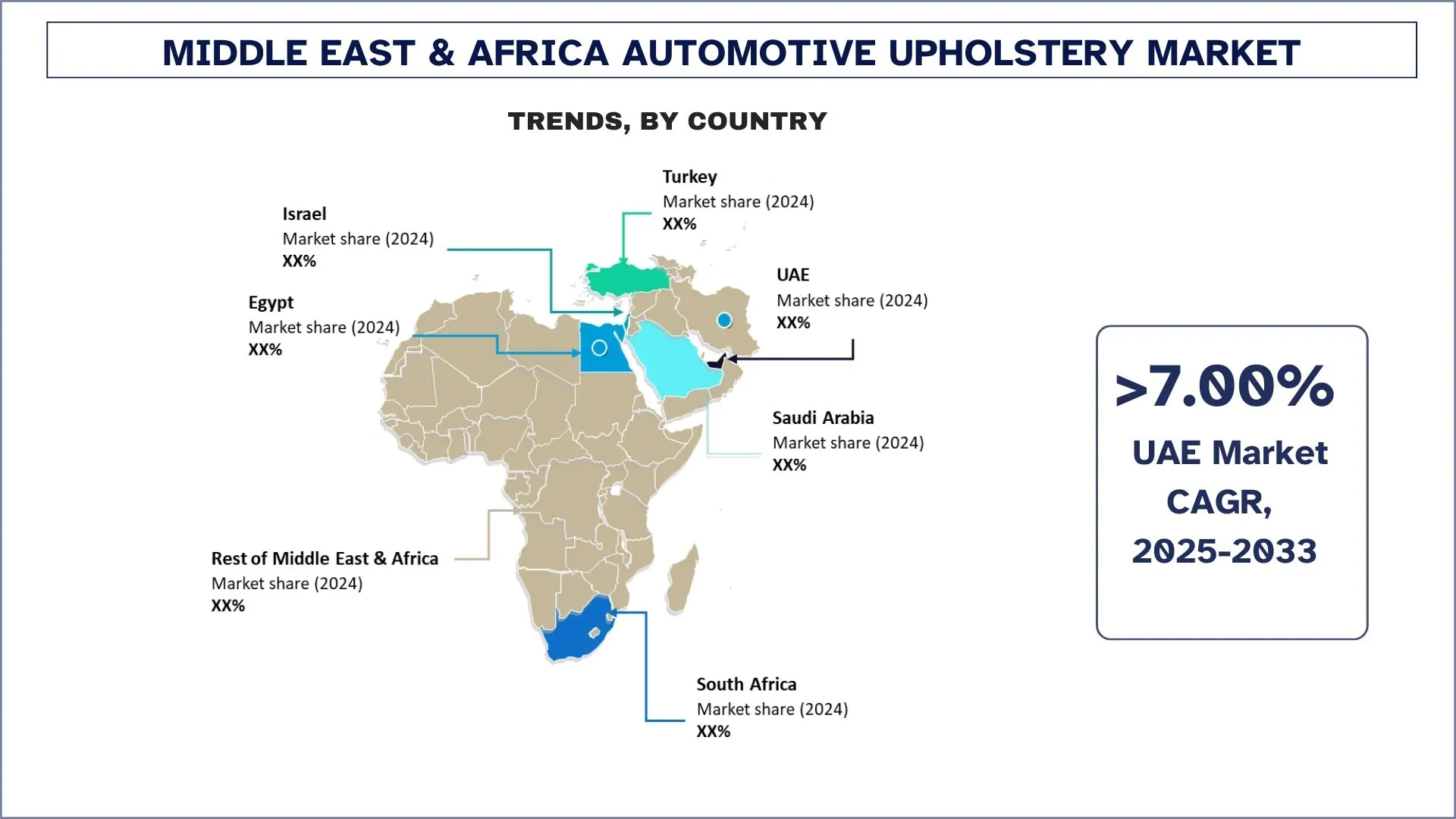
The UAE is expected to grow at a considerable rate during the forecast period.
The automotive upholstery market in the UAE is rising at the fastest rate within the Middle East and African region, which is powered by massive car parc growth, demand for premium cars, and the existence of a highly established customization and aftermarket market. The automation of the luxury SUVs, business fleets, and transport based on tourism demand more robust, unglamorous interiors that can endure high temperatures, UV rays, and dust. This rapidly increases the use of synthetic leather, coated fabrics, and perforated, breathable structures that are stain-resistant, easy to clean, and provide better thermal comfort. For instance, in 2025, the Abu Dhabi Investment Office (ADIO) and Abu Dhabi Ports signed a deal with global automaker Stellantis to develop an automotive ecosystem in Abu Dhabi (UAE).
Middle East & Africa Automotive Upholstery Industry Competitive Landscape:
The Middle East & Africa Automotive Upholstery market is competitive, with several global and international market players. The key players are adopting different growth strategies to enhance their market presence, such as partnerships, agreements, collaborations, new product launches, geographical expansions, and mergers and acquisitions.
Top Middle East & Africa Automotive Upholstery Companies
Some of the major players in the market are Cartex Italia, Motus Integrated Technologies, Sage Automotive Interiors, TESCA, Macflex International Ltd, Feltex, Lear, Hayashi Telempu Corporation, BEESDAM, Ltd., and Nutech.
Middle East & Africa Automotive Upholstery Market Report Coverage
Report Attribute | Details |
Base year | 2024 |
Forecast period | 2025-2033 |
Growth momentum | Accelerate at a CAGR of 6.50% |
Market size 2024 | USD 1,000 Million |
Country analysis | Saudi Arabia, UAE, Egypt, South Africa, Turkey, Israel, and the Rest of the Middle East & Africa |
Major contributing Country | Saudi Arabia is expected to dominate the market during the forecast period. |
Companies profiled | Cartex Italia, Motus Integrated Technologies, Sage Automotive Interiors, TESCA, Macflex International Ltd, Feltex, Lear, Hayashi Telempu Corporation, BEESDAM, Ltd., and Nutech. |
Report Scope | Market Trends, Drivers, and Restraints; Revenue Estimation and Forecast; Segmentation Analysis; Demand and Supply Side Analysis; Competitive Landscape; Company Profiling |
Segments Covered | by Vehicle Type, by Fabric Type, by Application, by Country |
Reasons to Buy the Middle East & Africa Automotive Upholstery Market Report:
The study includes market sizing and forecasting analysis confirmed by authenticated key industry experts.
The report briefly reviews overall industry performance at a glance.
The report covers an in-depth analysis of prominent industry peers, primarily focusing on key business financials, type portfolios, expansion strategies, and recent developments.
Detailed examination of drivers, restraints, key trends, and opportunities prevailing in the industry.
The study comprehensively covers the market across different segments.
Deep dive Country-level analysis of the industry.
Customization Options:
The Middle East & Africa AUTOMOTIVE UPHOLSTERY market can further be customized as per requirements or any other market segment. Besides this, UnivDatos understands that you may have your own business needs; hence, feel free to contact us to get a report that completely suits your requirements.
Table of Content
Research Methodology for the Middle East & Africa Automotive Upholstery Market Analysis (2023-2033)
We analyzed the historical market, estimated the current market, and forecasted the future market of the Middle East & Africa Automotive Upholstery market to assess its application in major countries. We conducted exhaustive secondary research to gather historical market data and estimate the current market size. To validate these insights, we carefully reviewed numerous findings and assumptions. Additionally, we conducted in-depth primary interviews with industry experts across the Automotive Upholstery value chain. After validating market figures through these interviews, we used both top-down and bottom-up approaches to forecast the overall market size. We then employed market breakdown and data triangulation methods to estimate and analyze the market size of industry segments and sub-segments.
Market Engineering
We employed data triangulation techniques to finalize the overall market estimation and derive precise statistical numbers for each segment and sub-segment of the Middle East & Africa Automotive Upholstery market. We split the data into several segments and sub-segments by analyzing various parameters and trends, by Vehicle Type, by Fabric Type, by Application, and by country within the Middle East & Africa Automotive Upholstery market.
The Main Objective of the Middle East & Africa Automotive Upholstery Market Study
The study identifies current and future trends in the Middle East & African Automotive Upholstery market, providing strategic insights for investors. It highlights Country-level market attractiveness, enabling industry participants to tap into untapped markets and gain a first-mover advantage. Other quantitative goals of the studies include:
Market Size Analysis: Assess the current forecast and market size of the Middle East & Africa Automotive Upholstery market and its segments in terms of value (USD).
Middle East & Africa Automotive Upholstery Market Segmentation: Segments in the study include areas by Vehicle Type, by Fabric Type, by Application, and by
Regulatory Framework & Value Chain Analysis: Examine the regulatory framework, value chain, customer behavior, and competitive landscape of the Middle East & Africa Automotive Upholstery industry.
Country Analysis: Conduct a detailed Country analysis for key areas such as Saudi Arabia, UAE, Egypt, South Africa, Turkey, Israel, and the Rest of the Middle East & Africa.
Company Profiles & Growth Strategies: Company profiles of the Middle East & Africa Automotive Upholstery market and the growth strategies adopted by the market players to sustain the fast-growing market.
Frequently Asked Questions FAQs
Q1: What is the Middle East & Africa Automotive Upholstery market’s current market size and growth potential?
The Middle East & Africa Automotive Upholstery market was valued at 1,000 million in 2024 and is expected to grow at a CAGR of 6.50% during the forecast period (2025-2033).
Q2: Which segment has the largest share of the Middle East & Africa Automotive Upholstery market by Vehicle Type?
The rising number of personal cars among the Middle East & African buyers, a higher focus on aesthetics of the personal car buyers as opposed to the commercial vehicle users, have promoted the rise of the automotive upholstery market in the MEA region.
Q3: What are the driving factors for the growth of the Middle East & Africa Automotive Upholstery market?
• Growing sales of SUVs and premium vehicles: Increasing preference for SUVs and higher-trim models is boosting demand for premium-looking, comfortable, and durable interior materials across OEM and aftermarket channels.
• Regional OEM/assembly expansion and localization push: New assembly capacity and localization initiatives are strengthening OEM demand, increasing the need for consistent quality, scalable supply, and faster turnaround from regional upholstery suppliers.
Q4: What are the emerging technologies and trends in the Middle East & Africa Automotive Upholstery market?
• Shift towards synthetic leather: Synthetic leather is gaining preference due to its premium appearance, lower maintenance, and better performance in heat and dust-prone conditions, with growing use of breathable perforated variants and protective finishes.
• Demand for functional interior surface: Buyers and fleets are prioritizing stain resistance, odor control, hygiene features, low glare, and thermal comfort, increasing uptake of coated fabrics, easy-clean surfaces, and performance-oriented constructions.
Q5: What are the key challenges in the Middle East & Africa Automotive Upholstery market?
• Competitive pressure from imports: Low-cost imported materials and ready-fit trim kits intensify pricing pressure, especially in the fragmented aftermarket, forcing local players to compete on customization, lead times, and fitment quality.
• Compliance and quality certifications: Growing OEM requirements for flammability, VOC limits, abrasion, fogging, and colorfastness are raising compliance costs and increasing the need for stronger testing, documentation, and standardized installation practices.
Q6: Which country dominates the Middle East & Africa Automotive Upholstery market?
Saudi Arabia has held a dominant market share in the automotive upholstery market in the Middle East & Africa region. Some of the key factors attributed to the rise of the Saudi Arabian market are high sales of automotives in the passenger as well as in the commercial category, as well as increasing demand for premium and luxury vehicles among customers, leading to the demand for high-quality materials being used in vehicles, including the upholstery.
Q7: Who are the key players in the Middle East & Africa Automotive Upholstery market?
Some of the top Automotive Upholstery companies in the Middle East & Africa include:
• Cartex Italia
• Motus Integrated Technologies
• Sage Automotive Interiors
• TESCA
• Macflex International Ltd
• Feltex
• Lear
• Hayashi Telempu Corporation
• BEESDAM
• Nutech
Q8: What are the opportunities for companies within the Middle East & Africa Automotive Upholstery market?
• Local manufacturing and supplier localization: Expanding vehicle assembly and localization programs across the region are creating opportunities for upholstery suppliers to establish regional production, conversion, and warehousing capabilities.
• Aftermarket customizations focus on customers: Rising demand for personalized interiors, especially in SUVs and premium vehicles, is accelerating growth in the aftermarket upholstery segment.
Q9: How are consumer preferences shaping product development in the Middle East & Africa Automotive Upholstery market?
Consumer preferences are pushing suppliers to develop upholstery that combines premium aesthetics with climate-ready performance. Demand is rising for synthetic leather, easy-clean and stain-resistant surfaces, breathable comfort, and UV-fade durability, alongside customization options and hygiene features that suit fleets and high-use vehicles.
Related Reports
Customers who bought this item also bought






Freight Railcar Repair Market: Current Analysis and Forecast (2025-2033)
Emphasis on Repair Type (Mechanical (Brake System, Coupler & Draft Gears, Bearing & Axles, Wheels & Wheelsets, Doors & hatches, Pneumatic Systems, Others), Structural (Boday & Frame Repair, Welding & Metalworks, Corrosion Prevention & Repair, Roof, sides & Underbody Repair, Others), Interior (Flooring & Subflooring, Interior Lining & Insulation, Others)); By Service (Mobile, On-Site); and Region/Country
May 9, 2025

Automotive Sprocket Market: Current Analysis and Forecast (2025-2033)
Emphasis on Product Type (Timing Sprockets, Roller Chain Sprockets, Silent Chain Sprockets, and Others); Vehicle Type (Two-Wheelers, Passenger Cars, Light Commercial Vehicles, Heavy Commercial Vehicles, and Electric Vehicles (EVs) & Hybrid Vehicles); Sales Channel (Aftermarket and Original Equipment Manufacturer (OEM)); and Region/Country
May 6, 2025