- Home
- About Us
- Industry
- Services
- Reading
- Contact Us
Middle East & Africa Solar Hybrid Inverter Market: Current Analysis and Forecast (2025-2033)
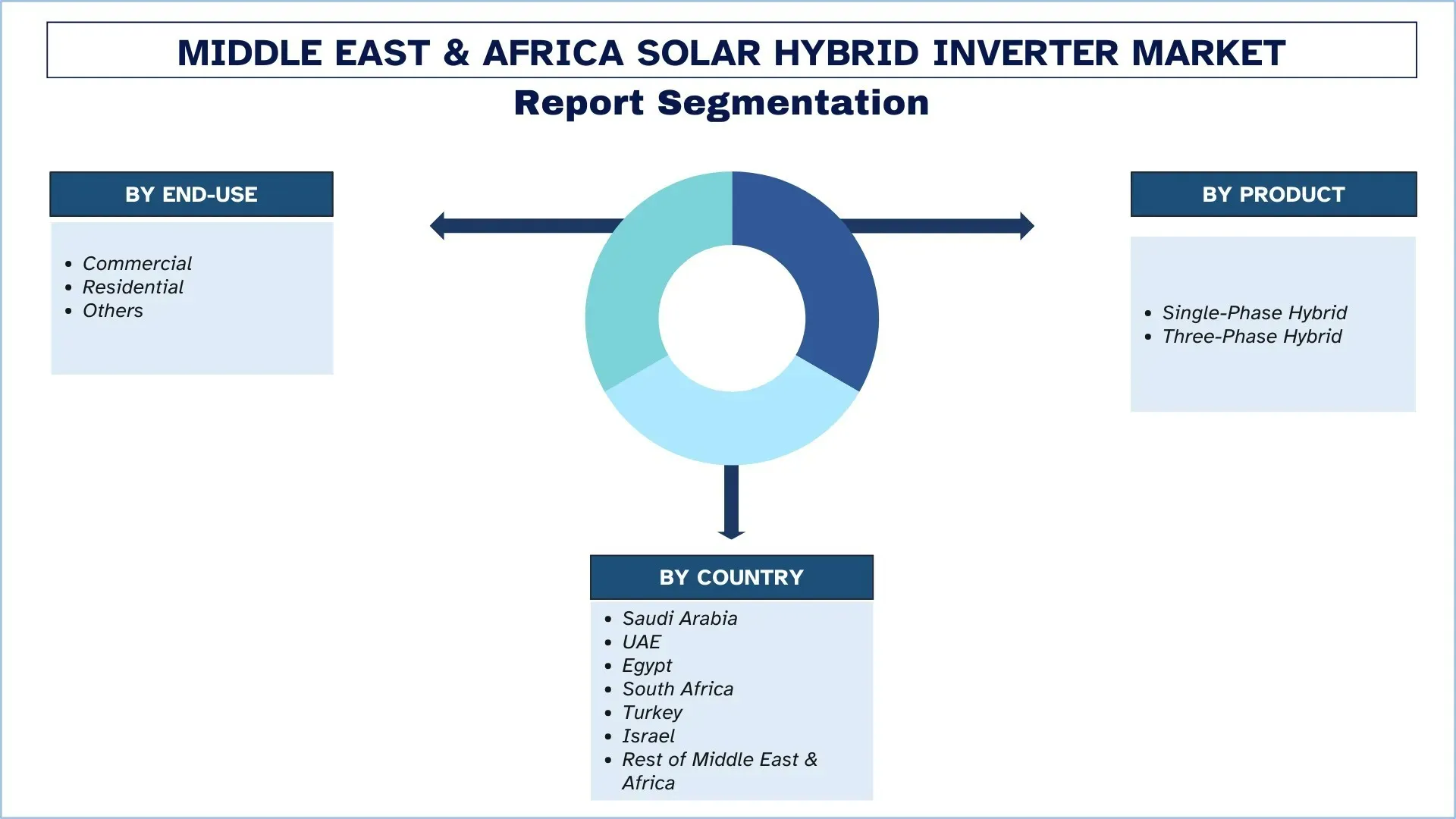
Emphasis By End-Use (Commercial, Residential, and Others), By Product (Single-Phase Hybrid and Three-Phase Hybrid), By Country (Saudi Arabia, UAE, Egypt, South Africa, Turkey, Israel, and the Rest of Middle East & Africa)
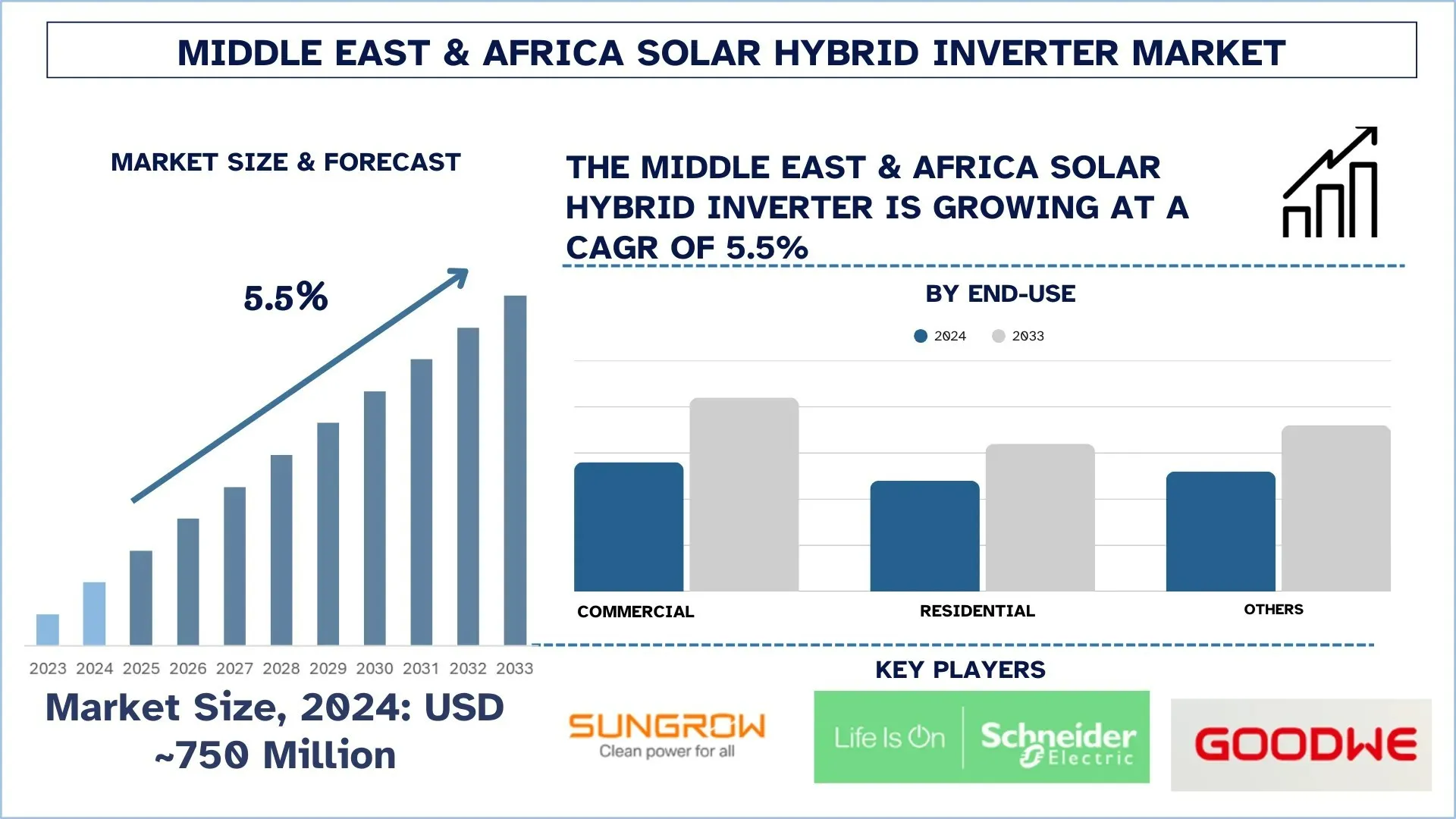
Middle East & Africa Solar Hybrid Inverter Market Size & Forecast
The Middle East & Africa Solar Hybrid Inverter Market was valued at USD 750 million in 2024 and is expected to grow at a strong CAGR of around 5.50% during the forecast period (2025- 2033F). Increasing Demand for Backup Power with Reliability, and Growing Demand for Solar Power in the MEA Region are some of the key factors that have supported the market growth in the Middle East & Africa region.
Middle East & Africa Solar Hybrid Inverter Market Analysis
The Middle East & Africa Solar Hybrid Inverter market has shown a fast-paced growth in the historical years. With the rising number of solar power plants/small-scale solar installations, a jump in the demand for solar hybrid inverters has been observed. Additionally, the declining cost of solar panels and allied systems has also promulgated the adoption of public and private sector for the solar power for backup power. GCC market deployments are further being driven by government incentives, net-metering policies, and electrification programs in GCC and Sub-Saharan markets, especially in off-grid communities and telecom towers, as well as commercial facilities vulnerable to grid instability. Hybrid inverters that combine battery storage, diesel gensets, and smart energy applications are becoming popular due to reduced fuel consumption and enhanced reliability. There is also an expansion of service networks and localized assembly by vendors.
Middle East & Africa Solar Hybrid Inverter Market Trends
This section discusses the key market trends that are influencing the various segments of the Middle East & Africa Solar Hybrid Inverter market, as found by our team of research experts.
Emerging Demand from the Residential Sector Due to Cost Saving:
With the growing urban population and government plans across the various emerging nations in the Middle East & Africa region, the demand for sustainable and continuous power has extensively grown. Additionally, the high-rise societies, urban settlements, have been installing solar panels for independent power solutions on a long-term basis, which have proven to be crucial for enhancing the demand for the hybrid solar inverters.
Additionally, various large-scale government plans such as NEOM (Saudi Arabia), New Capital City (Egypt), expansion of urban planning near Dubai (UAE), etc., are also anticipated to be crucial for the adoption of renewable power solutions which would fetch the demand for allied systems such as storage devices, solar installation, fitments as well as hybrid solar inverters.
Considering the rising number of residential spaces and independent power requirements, the demand for solar hybrid inverters is further anticipated to emerge as a key trend supporting the market rise in the coming years.
Key Market Segmentation:
This section provides an analysis of the key trends in each segment of the Middle East & Africa Solar Hybrid Inverter market report, along with forecasts at the country and regional levels for 2025-2033.
The Commercial segment has shown promising growth in the Solar Hybrid Inverter Market.
The Middle East and Africa market of Solar Hybrid inverters has been identified based on end-use as commercial, residential, and others. Out of them, the commercial sector has occupied the greater market share, attributed to the increased power demands and the enhanced business argument that it should reduce its consumption of diesel and its exposure to unreliable grids. Hybrid systems are increasingly becoming popular with commercial users, including telecom towers, retail stores, warehouses, farms, and small industrial locations, to ensure system uptime and regulate operating expenses. Also, bigger rooftop areas, simplified financing of the project, and shorter payback time than households contribute to increased commercial deployments. C&I programs and net-metering policies that are supported by the government contribute to adoption.
The Three-Phase Hybrid category held a significant share of the Middle East & Africa Solar Hybrid Inverter Market.
Three-phase hybrid inverters have dominated the market mainly because of their ability to work at high loads and function better in commercial and industrial (C&I) installations, large residential villas, and utility/mini-grid projects prevalent in the Middle East and Africa. Three-phase architectures allow more load balancing, higher power ratings, enhanced motor-start capability (HVAC, pumps, compressors), and provide scalability of the system, which is important in areas where it is critical to have uptime and grid availability may be less predictable. They are also more compatible with bigger battery banks and higher DC PV capacities that can cover peak shaving, demand management, and backup power needs of mission-critical operations. In comparison, single-phase hybrid inverters (which remain available) have continued to be adopted flat in small homes and small businesses due to low installation cost, easier installations, and small backup and self-consumption needs. Their small power processing and scalability normally limit their use to entry-level distributed systems, though.
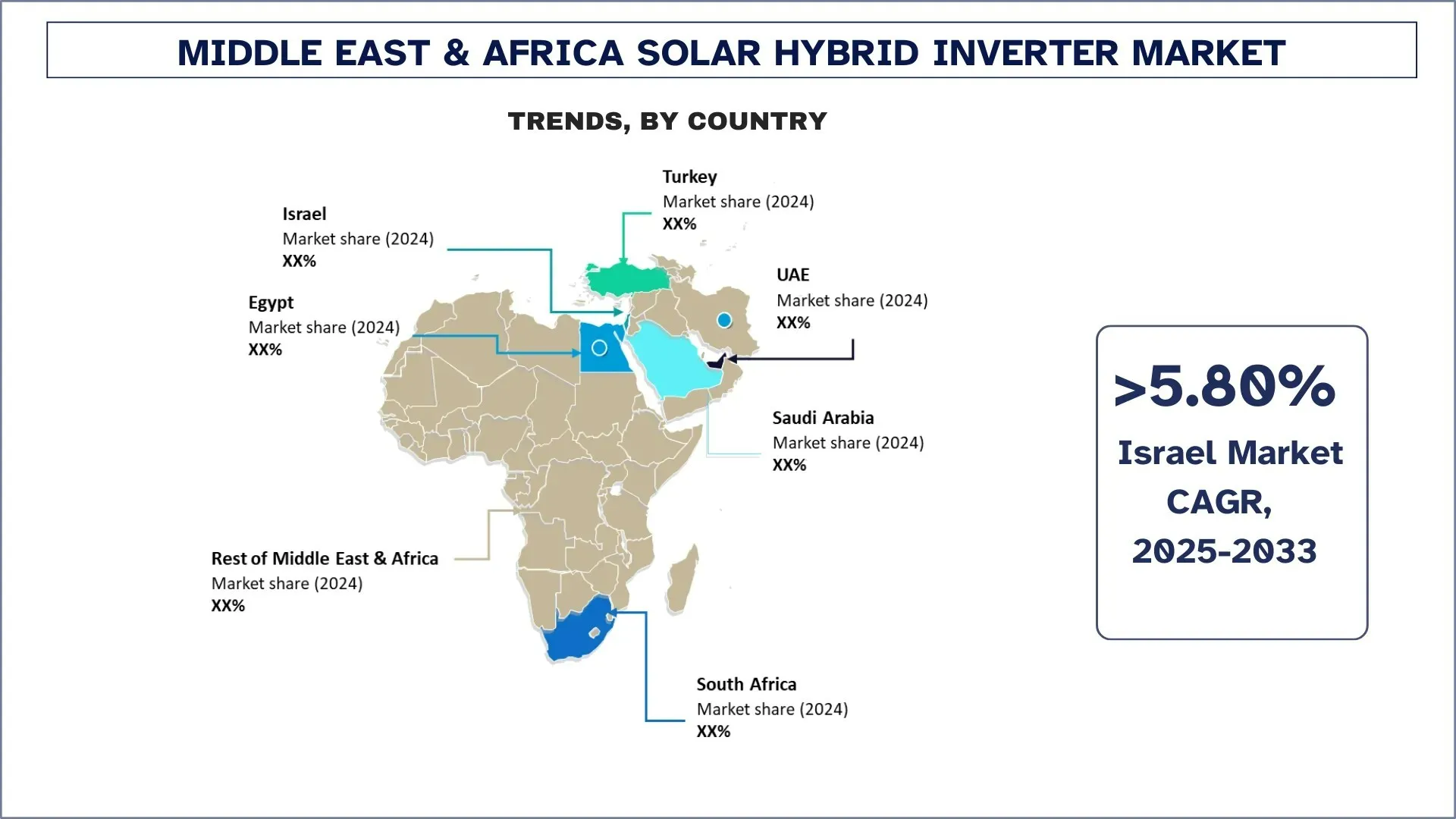
Israel is expected to grow at a considerable rate during the forecast period.
The market of solar hybrid inverters in Israel is showing a healthy growth and is based on the fact that the country has a high focus on the integration of renewable energy and energy security. Hybrid inverters are becoming popular due to the ability to couple solar generation, storage, and grid support with a seamless and consistent change in grid fluctuations and increasing residential and commercial solar deployments. Feed-in tariffs and net-metering reforms are some of the government incentives promoting the use of rooftop solar between households and SMEs. Also, the orientation towards intelligent energy management and technological innovation in Israel leads to the demand for intelligent and high-efficiency hybrid inverters with remote monitoring, cybersecurity, and high functionality at high ambient temperatures and dusty environments.
In 2025, Israel's Finance Ministry announced it would establish a new solar power plant with a battery storage system at the Ashalim power station in the country's south.
Middle East & Africa Solar Hybrid Inverter Industry Competitive Landscape:
The Middle East & Africa Solar Hybrid Inverter market is competitive, with several global and international market players. The key players are adopting different growth strategies to enhance their market presence, such as partnerships, agreements, collaborations, new product launches, geographical expansions, and mergers and acquisitions.
Top Middle East & Africa Solar Hybrid Inverter Companies
Some of the major players in the market are Huawei Technologies Co., Ltd., Sungrow Power Supply Co., Ltd., SMA Solar Technology AG, Schneider Electric SE, Fimer S.p.A., GoodWe Technologies Co., Ltd., Ningbo Deye Inverter Technology Co., ARTsolar, Egypt Power, and Synergx.
Middle East & Africa Solar Hybrid Inverter Market Report Coverage
Report Attribute | Details |
Base year | 2024 |
Forecast period | 2025-2033 |
Growth momentum | Accelerate at a CAGR of 5.50% |
Market size 2024 | USD 750 Million |
Country analysis | Saudi Arabia, UAE, Egypt, South Africa, Turkey, Israel, and the Rest of the Middle East & Africa |
Major contributing Country | Saudi Arabia is expected to dominate the market during the forecast period. |
Companies profiled | Huawei Technologies Co., Ltd., Sungrow Power Supply Co., Ltd., SMA Solar Technology AG, Schneider Electric SE, Fimer S.p.A., GoodWe Technologies Co., Ltd., Ningbo Deye Inverter Technology Co., ARTsolar, Egypt Power, and Synergx. |
Report Scope | Market Trends, Drivers, and Restraints; Revenue Estimation and Forecast; Segmentation Analysis; Demand and Supply Side Analysis; Competitive Landscape; Company Profiling |
Segments Covered | by End-Use, by Product, by Country |
Reasons to Buy the Middle East & Africa Solar Hybrid Inverter Market Report:
The study includes market sizing and forecasting analysis confirmed by authenticated key industry experts.
The report briefly reviews overall industry performance at a glance.
The report covers an in-depth analysis of prominent industry peers, primarily focusing on key business financials, type portfolios, expansion strategies, and recent developments.
Detailed examination of drivers, restraints, key trends, and opportunities prevailing in the industry.
The study comprehensively covers the market across different segments.
Deep dive Country-level analysis of the industry.
Customization Options:
The Middle East & Africa Solar Hybrid Inverter market can further be customized as per requirements or any other market segment. Besides this, UnivDatos understands that you may have your own business needs; hence, feel free to contact us to get a report that completely suits your requirements.
Table of Content
Research Methodology for the Middle East & Africa Solar Hybrid Inverter Market Analysis (2023-2033)
We analyzed the historical market, estimated the current market, and forecasted the future market of the Middle East & Africa Solar Hybrid Inverter market to assess its application in major countries. We conducted exhaustive secondary research to gather historical market data and estimate the current market size. To validate these insights, we carefully reviewed numerous findings and assumptions. Additionally, we conducted in-depth primary interviews with industry experts across the Solar Hybrid Inverter value chain. After validating market figures through these interviews, we used both top-down and bottom-up approaches to forecast the overall market size. We then employed market breakdown and data triangulation methods to estimate and analyze the market size of industry segments and sub-segments.
Market Engineering
We employed data triangulation techniques to finalize the overall market estimation and derive precise statistical numbers for each segment and sub-segment of the Middle East & Africa Solar Hybrid Inverter market. We split the data into several segments and sub-segments by analyzing various parameters and trends, by End-Use, by Product, and by country within the Middle East & Africa Solar Hybrid Inverter market.
The Main Objective of the Middle East & Africa Solar Hybrid Inverter Market Study
The study identifies current and future trends in the Middle East & African Solar Hybrid Inverter market, providing strategic insights for investors. It highlights Country-level market attractiveness, enabling industry participants to tap into untapped markets and gain a first-mover advantage. Other quantitative goals of the studies include:
Market Size Analysis: Assess the current forecast and market size of the Middle East & Africa Solar Hybrid Inverter market and its segments in terms of value (USD).
Middle East & Africa Solar Hybrid Inverter Market Segmentation: Segments in the study include areas by End-Use, by Product, and by
Regulatory Framework & Value Chain Analysis: Examine the regulatory framework, value chain, customer behavior, and competitive landscape of the Middle East & Africa Solar Hybrid Inverter industry.
Country Analysis: Conduct a detailed Country analysis for key areas such as Saudi Arabia, UAE, Egypt, South Africa, Turkey, Israel, and the Rest of the Middle East & Africa.
Company Profiles & Growth Strategies: Company profiles of the Middle East & Africa Solar Hybrid Inverter market and the growth strategies adopted by the market players to sustain the fast-growing market.
Frequently Asked Questions FAQs
Q1: What is the Middle East & Africa Solar Hybrid Inverter market’s current market size and growth potential?
The Middle East & Africa Solar Hybrid Inverter market was valued at 750 million in 2024 and is expected to grow at a CAGR of 5.50% during the forecast period (2025-2033).
Q2: Which segment has the largest share of the Middle East & Africa Solar Hybrid Inverter market by End-Use?
The commercial sector has occupied the greater market share, attributed to the increased power demands and the enhanced business argument that it should reduce its consumption of diesel and its exposure to unreliable grids.
Q3: What are the driving factors for the growth of the Middle East & Africa Solar Hybrid Inverter market?
• Increasing demand for backup power with reliability: Frequent outages, voltage fluctuations, and weak-grid conditions are pushing residential, commercial, and critical-load users to adopt hybrid inverters that can ensure uninterrupted supply through PV-plus-battery operation.
• Growing demand for solar power in the MEA region: Strong solar irradiation, accelerating renewable targets, and expanding project pipelines are increasing solar deployments, which directly lifts demand for hybrid inverters as a core balance-of-system component.
Q4: What are the emerging technologies and trends in the Middle East & Africa Solar Hybrid Inverter market?
• Emerging demand from the residential sector due to cost savings: Households and high-rise communities are installing rooftop solar with storage-ready configurations to reduce long-term electricity costs and improve self-consumption, accelerating hybrid inverter adoption.
• Rising demand for smart inverters for extreme climatic conditions: High temperatures, dust, and humidity are increasing the preference for ruggedized smart inverters with improved thermal management, higher IP ratings, remote monitoring, and enhanced protection features to reduce downtime.
Q5: What are the key challenges in the Middle East & Africa Solar Hybrid Inverter market?
• High cost of installation of solar plants: Upfront CAPEX for PV systems, storage, and associated civil/electrical works remains a key barrier, particularly for price-sensitive residential users and SMEs without accessible financing.
• Regulatory constraints and complex interconnection rules: Permitting delays, varied grid codes, and interconnection complexity across countries can extend project timelines and increase compliance costs, limiting faster adoption.
Q6: Which country dominates the Middle East & Africa Solar Hybrid Inverter market?
Saudi Arabia has held a dominant market share in the Solar Hybrid Inverter market in the Middle East & Africa region. Some of the key factors that have contributed to the higher market share of the country are the rising number of solar installations, both in the residential sector and in power grid applications. Additionally, the region also experiences extreme climatic conditions, leading to the failure of electrical components, and further demand for smart hybrid inverters for renewable energy applications.
Q7: Who are the key players in the Middle East & Africa Solar Hybrid Inverter market?
Some of the top Solar Hybrid Inverter companies in the Middle East & Africa include:
• Huawei Technologies Co., Ltd.
• Sungrow Power Supply Co., Ltd.
• SMA Solar Technology AG
• Schneider Electric SE
• Fimer S.p.A.
• GoodWe Technologies Co., Ltd.
• Ningbo Deye Inverter Technology Co.
• ARTsolar
• Egypt Power
• Synergx
Q8: What are the opportunities for companies within the Middle East & Africa Solar Hybrid Inverter market?
• Mini-grid & last-mile electrification: National electrification programs and donor-backed projects are expanding mini-grid deployments, where hybrid inverters play a central role in managing PV, storage, and backup generation for a reliable supply.
• Emerging demand in developing countries: Rapid population growth, low electrification rates in select markets, and rising energy access investments are creating sustained demand for scalable, cost-optimized hybrid inverter solutions.
Q9: How are consumer preferences shaping product development in the Middle East & Africa Solar Hybrid Inverter market?
Consumer preferences are steering product development toward durable, smart hybrid inverters that deliver seamless backup power, higher efficiency, and lower lifecycle costs. Buyers increasingly expect heat- and dust-resistant designs, remote monitoring, fast serviceability, and storage-ready flexibility to support self-consumption and decentralized electrification.
Related Reports
Customers who bought this item also bought