- Home
- About Us
- Industry
- Services
- Reading
- Contact Us
Southeast Asia Cloud Gaming Market: Current Analysis and Forecast (2025-2033)
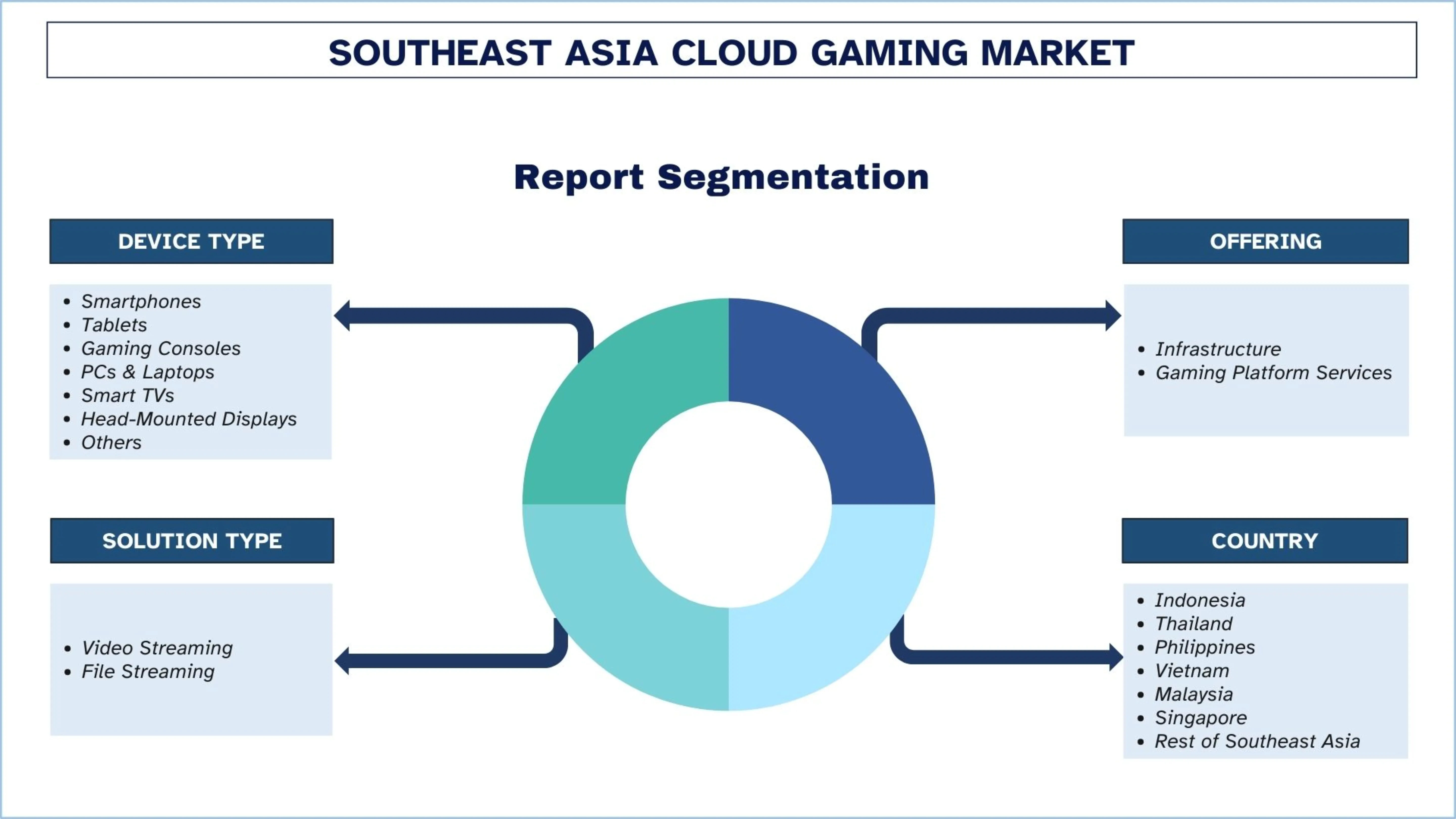
Emphasis on Device Type (Smartphones, Tablets, Gaming Consoles, PCs & Laptops, Smart TVs, Head-Mounted Displays, Others); Offering (Infrastructure, Gaming Platform Services); Solution Type (Video Streaming, File Streaming); and Country.
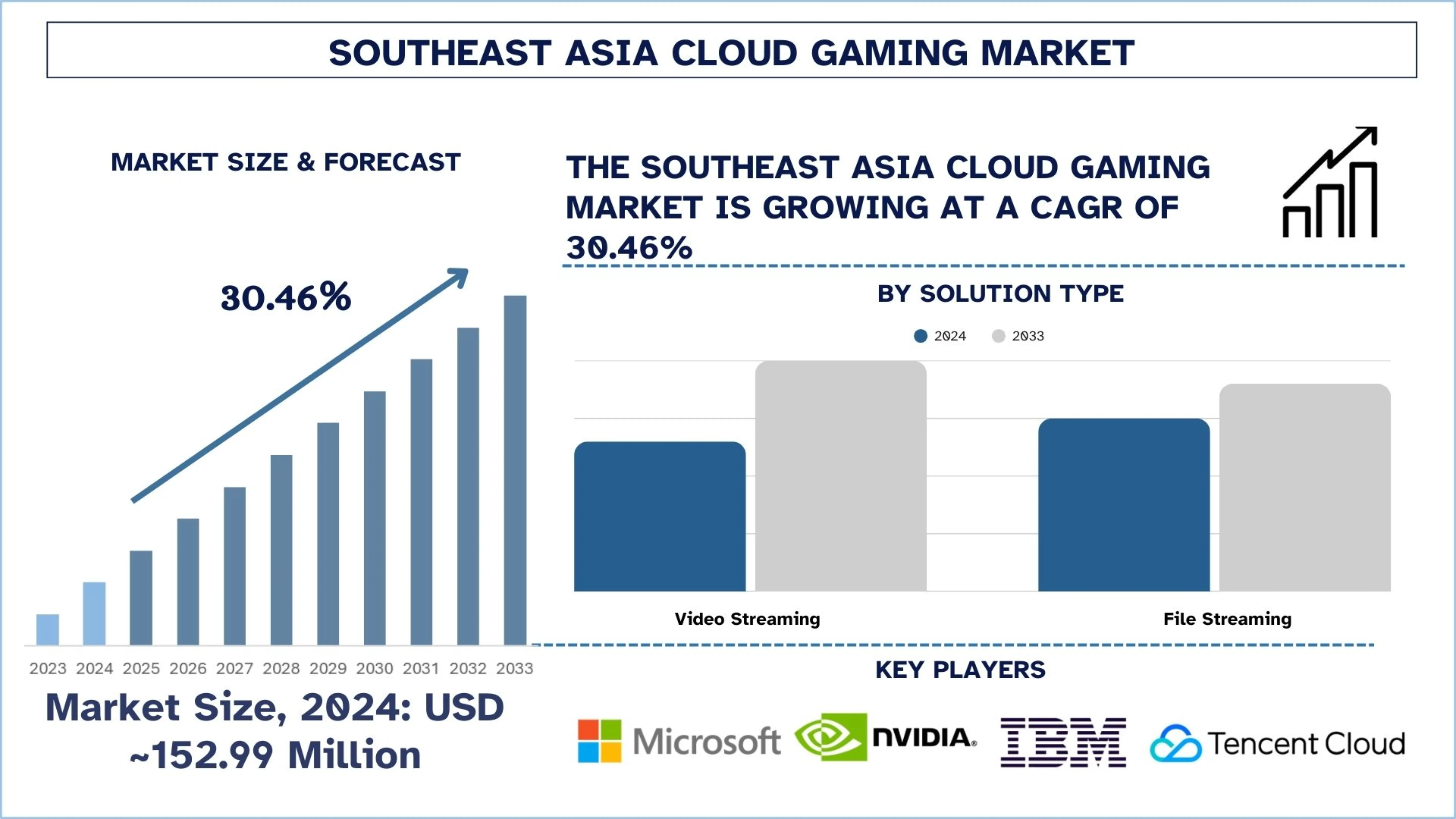
Southeast Asia Cloud Gaming Market Size & Forecast
The Southeast Asia Cloud Gaming Market was valued at ~USD 152.99 million in 2024 and is expected to grow at a strong CAGR of approximately 30.46% during the forecast period (2025-2033F), driven by the rapid 5G and fiber network expansion and increasing smartphone usage.
Southeast Asia Cloud Gaming Market Analysis
Cloud Gaming is an electronic, sensor-based product worn on the body to monitor, diagnose, or assist in the real-time management of health conditions. These devices capture physiological data and transmit it to healthcare systems to facilitate continuous clinical monitoring and decision-making.
To enable faster access to cloud gaming, providers are establishing edge data centers near consumers to minimize latency and improve performance. Combined with 5G and fiber broadband networks, it is making it easier to achieve smooth, high-framerate gameplay on mobile and home devices. Moreover, platforms are investing in device compatibility, ensuring games work across smartphones, smart TVs, PCs, and consoles. Furthermore, AI-driven optimization of streaming and adaptive bitrate technologies is being used to address network variability in the region.
For example, on November 17, 2025, Tencent Cloud enhanced local presence in Southeast Asia, underpinned by global AI and cloud capabilities. Travelers passing through Singapore's Changi Airport, one of the world's busiest travel hubs, are now greeted by a prominent display of Tencent Cloud's brand.
For example, on September 4, 2025, Singtel and Tencent Games announced the launch of Honor of Kings ∙ Cloud (HoK ∙ Cloud) using Singtel’s 5G network slicing technology. This world-first deployment employs Singtel’s advanced 5G network to deliver dedicated, low-latency capabilities to enable smoother, more competitive game play for players at home or on the move. With this technology, players will no longer have to deal with heavy downloads or high-end hardware, as all intense processing and rendering takes place in the cloud, making it easier for players to game on any mobile device. Singtel’s network slicing capability also boosts real-time processing across IoT devices and supports generative AI for smart glasses.
Southeast Asia Cloud Gaming Market Trends
This section discusses the key market trends that are influencing the various segments of the Southeast Asia Cloud Gaming market, as found by our team of research experts.
Growing Role of AI in Streaming Optimization
There is an increasing implementation of AI into cloud gaming systems to augment the quality of streaming and gameplay in Southeast Asia. Applications of machine learning algorithms in video compression, dynamic resolution adjustment, and real-time prediction of network congestion are optimized. This will minimize the latency, buffering, and frame drops even in dynamic mobile and broadband networks. The use of AI-based optimization is of great significance to the field, given the geographic variability of network performance. With the expansion of cloud gaming services offered by providers, AI stands out as a fundamental resource for delivering a consistent and responsive user experience and for managing infrastructure costs.
Southeast Asia Cloud Gaming Industry Segmentation
This section provides an analysis of the key trends in each segment of the Southeast Asia Cloud Gaming market, along with forecasts at the country level for 2025-2033.
The smartphones segment held the dominant share of the Cloud Gaming market in 2024.
Based on device type, the market is segmented into smartphones, tablets, gaming consoles, PCs & laptops, smart TVs, head-mounted displays, and others. Among these, the smartphones segment held the largest share in 2024. This is mainly due to the growing adoption of cloud gaming, which is highly affordable and accessible. The widespread adoption of mobile internet and the expanding 4G and 5G coverage enable users to access cloud gaming services without investing in high-end hardware. This mobile-first practice allows companies to scale fast and have access to mass-market users in urban and semi-urban locations.
The file streaming segment is expected to grow at a significant CAGR during the forecast period (2025-2033).
Based on the solution type, the market is segmented into video streaming and file streaming. Among these, the file streaming segment is expected to grow at a significant CAGR during the forecast period (2025-2033). This is mainly because it allows hybrid models of gameplay that can reduce bandwidth load and enhance performance on variable networks. This method enables progressive streaming game assets at the cost of partial local processing, enabling cloud computing in areas where there is erratic connectivity. With the quality of the network, file streaming assists firms in optimizing expenses and reaching even outside the premium network areas.
Indonesia held a dominant share of the Southeast Asian Cloud Gaming market in 2024
Indonesia leads the cloud gaming market in Southeast Asia and is poised to expand, driven by a large gaming population and high levels of mobile-first digital behaviour. The use of 4G and 5G networks, alongside the expansion of fiber connectivity, is enabling scalable deployment of cloud gaming. Adding to this, the low cost of data plans and the rise in the use of digital wallets promote the use of subscriptions. Moreover, the high youth population and the growing demand for online entertainment in the country will be essential drivers of growth for companies seeking to expand their cloud gaming offerings.
For example, on November 10, 2024, in a significant boost to Indonesia’s digital economy and Golden Indonesia 2045 vision, GoTo Group, Tencent Cloud, and Alibaba Cloud signed agreements that will boost cloud infrastructure and digital talent development in Indonesia.
Southeast Asia Cloud Gaming Industry Competitive Landscape
The Southeast Asia Cloud Gaming market is competitive, with several global and international market players. The key players are adopting different growth strategies to enhance their market presence, such as partnerships, agreements, collaborations, new product launches, geographical expansions, and mergers and acquisitions.
Top Southeast Asia Cloud Gaming Companies
Some of the major players in the market are Microsoft, NVIDIA Corporation, IBM, Tencent Cloud, VNG Cloud (VNG Corporation), Sony Group Corporation, Blacknut, True Digital Group Company Limited, gameQoo, AirConsole (KPIT).
Recent Developments in the Southeast Asia Cloud Gaming Market
On November 11, 2025, Tencent announced several new strategic partnerships at Tencent Cloud Day Singapore 2025, reaffirming its commitment to building a collaborative AI ecosystem that empowers businesses, institutions, and communities across the Asia Pacific. Themed “AI-Powered Global Opportunities,” the event brought together industry leaders, partners, and clients to explore how AI-powered technologies are reshaping industries and unlocking new avenues for sustainable growth. It is held a day before the Singapore Fintech Festival 2025.
Southeast Asia Cloud Gaming Market Report Coverage
Report Attribute | Details |
Base year | 2024 |
Forecast period | 2025-2033 |
Growth momentum | Accelerate at a CAGR of 30.46% |
Market size 2024 | ~USD 152.99 million |
Country analysis | Indonesia, Thailand, Philippines, Vietnam, Malaysia, Singapore, Rest of Southeast Asia |
Major contributing Country | Vietnam is expected to grow at the highest CAGR during the forecasted period. |
Companies profiled | Microsoft, NVIDIA Corporation, IBM, Tencent Cloud, VNG Cloud (VNG Corporation), Sony Group Corporation, Blacknut, True Digital Group Company Limited, gameQoo, AirConsole (KPIT) |
Report Scope | Market Trends, Drivers, and Restraints; Revenue Estimation and Forecast; Segmentation Analysis; Demand and Supply Side Analysis; Competitive Landscape; Company Profiling |
Segments Covered | By Device Type, By Offering, By Solution Type, By Country |
Reasons to Buy the Southeast Asia Cloud Gaming Market Report:
The study includes market sizing and forecasting analysis confirmed by authenticated key industry experts.
The report briefly reviews overall industry performance at a glance.
The report covers an in-depth analysis of prominent industry peers, primarily focusing on key business financials, product portfolios, expansion strategies, and recent developments.
Detailed examination of drivers, restraints, key trends, and opportunities prevailing in the industry.
The study comprehensively covers the market across different segments.
Customization Options:
The Southeast Asia Cloud Gaming Market can further be customized as per requirements or any other market segment. Besides this, UnivDatos understands that you may have your own business needs; hence, feel free to contact us to get a report that completely suits your requirements.
Table of Content
Research Methodology for the Southeast Asia Cloud Gaming Market Analysis (2023-2033)
We analyzed the historical market, estimated the current market, and forecasted the future market of the Southeast Asian Cloud Gaming market to assess its application in major countries. We conducted exhaustive secondary research to gather historical market data and estimate the current market size. To validate these insights, we carefully reviewed numerous findings and assumptions. Additionally, we conducted in-depth primary interviews with industry experts across the Southeast Asian Cloud Gaming value chain. After validating market figures through these interviews, we used both top-down and bottom-up approaches to forecast the overall market size. We then employed market breakdown and data triangulation methods to estimate and analyze the market size of industry segments and sub-segments.
Market Engineering
We employed the data triangulation technique to finalize the overall market estimation and derive precise statistical numbers for each segment and sub-segment of the Southeast Asia Cloud Gaming market. We split the data into several segments and sub-segments by analyzing various parameters and trends, including device type, application, end-user, and country within the Southeast Asian Cloud Gaming market.
The Main Objective of the Southeast Asia Cloud Gaming Market Study
The study identifies current and future trends in the Southeast Asia Cloud Gaming market, providing strategic insights for investors. It highlights market attractiveness, enabling industry participants to tap into untapped markets and gain a first-mover advantage. Other quantitative goals of the studies include:
Market Size Analysis: Assess the current and forecast market size of the Southeast Asia Cloud Gaming market and its segments in terms of value (USD).
Southeast Asia Cloud Gaming Market Segmentation: Segments in the study include areas of device type, application, end-user, and country.
Regulatory Framework & Value Chain Analysis: Examine the regulatory framework, value chain, customer behavior, and competitive landscape of the Southeast Asia Cloud Gaming industry.
Country Analysis: Conduct a detailed country analysis for key areas such as Indonesia, Thailand, the Philippines, Vietnam, Malaysia, Singapore, and the Rest of Southeast Asia.
Company Profiles & Growth Strategies: Company profiles of the Southeast Asia Cloud Gaming market and the growth strategies adopted by the market players to sustain the fast-growing market.
Frequently Asked Questions FAQs
Q1: What is the Southeast Asia Cloud Gaming market’s current market size and growth potential?
The Southeast Asia Cloud Gaming market was valued at ~USD 152.99 million in 2024 and is projected to expand at a CAGR of 30.46% from 2025 to 2033. This rapid growth is supported by rising 5G and fiber penetration, increasing mobile gaming adoption, and expanding cloud infrastructure across the region.
Q2: Which segment has the largest share of the Southeast Asia Cloud Gaming market by device type?
Smartphones dominate the Southeast Asia Cloud Gaming market by device type due to the region’s mobile-first consumer behavior, high smartphone penetration, and widespread availability of affordable data plans. Cloud gaming enables users to access premium games without investing in consoles or gaming PCs.
Q3: What are the driving factors for the growth of the Southeast Asia Cloud Gaming market?
Market growth is driven by rapid 5G and fiber network expansion, increasing smartphone usage, a large young gaming population, and the elimination of high hardware costs through cloud-based delivery. Additionally, telecom-bundled gaming services and improved digital payment ecosystems are accelerating adoption.
Q4: What are the emerging technologies and trends in the Southeast Asia Cloud Gaming market?
Key trends include the growing role of AI in streaming optimization, rising adoption of subscription-based gaming models, increased deployment of edge data centers, and expanding compatibility across smart TVs and multiple devices. These trends are improving user experience while enhancing platform scalability.
Q5: What are the key challenges in the Southeast Asia Cloud Gaming market?
Major challenges include inconsistent network quality across countries, high GPU and infrastructure costs, low ARPU in price-sensitive markets, and content licensing complexities. Managing latency and delivering a consistent user experience across diverse devices also remains a critical challenge.
Q6: Which country dominates the Southeast Asia Cloud Gaming market?
Indonesia dominates the Southeast Asia Cloud Gaming market due to its large gaming population, high mobile internet usage, and expanding telecom and cloud infrastructure. Affordable data pricing and strong engagement in online gaming further support market leadership.
Q7: Who are the key players in the Southeast Asia Cloud Gaming market?
Leading companies in the Southeast Asia Cloud Gaming market include:
• Microsoft
• NVIDIA Corporation
• IBM
• Tencent Cloud
• VNG Cloud (VNG Corporation)
• Sony Group Corporation
• Blacknut
• True Digital Group Company Limited
• gameQoo
• AirConsole (KPIT)
Q8: How are telecom operators contributing to the growth of cloud gaming in Southeast Asia?
Telecom operators are accelerating cloud gaming adoption by bundling gaming services with 5G and fiber plans, deploying edge infrastructure, and offering optimized data packages. These partnerships help reduce latency, lower entry barriers, and expand reach across urban and semi-urban areas.
Q9: Why is Southeast Asia considered a high-growth region for cloud gaming investments?
Southeast Asia offers a combination of a large young population, rising digital consumption, improving network infrastructure, and relatively low market penetration. This creates strong long-term growth potential for cloud gaming platforms, infrastructure providers, and investors.
Related Reports
Customers who bought this item also bought


3D Printing Market: Current Analysis and Forecast (2025-2033)
Emphasis on Component ((Product (Professional/Industrial Printer, Personal/Desktop 3D Printers), Material (Polymer, Plastic, Metals and Alloys, Ceramic, Other Materials), Technology ( Stereolithography, Selective Laser Sintering, Electron Beam Melting, Fused Deposition Modelling, Laminated object Manufacturing, Other Technologies))
April 29, 2025